How to Play The Blackest Crow on Banjo - Clawhammer Tab & Lesson
About This Song
The Blackest Crow is one of the most beautiful songs you can play on the banjo. It's a haunting folk song that has been sung in the Appalachian and Ozark mountains for generations. The melody is simple but powerful, and it sounds absolutely gorgeous on the banjo.
What makes this one special is the waltz time signature. Most old-time banjo tunes are in 4/4 time, so playing in 3/4 is a refreshing change. It takes a little getting used to, but once you feel that three-beat rhythm, it's incredibly satisfying. The song uses four chords (D, C, G, and Em) and the melody is actually quite simple once you're comfortable with the rhythm.
The Blackest Crow Clawhammer Banjo Tab
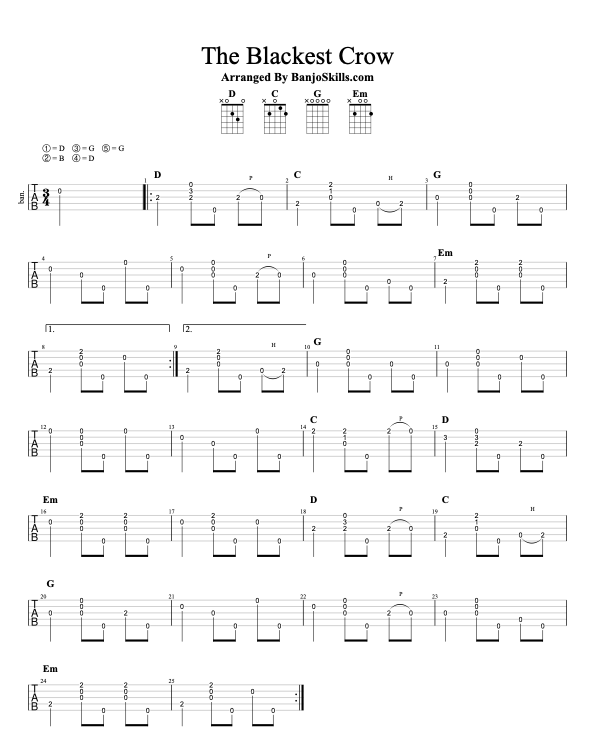
Get the Free Printable The Blackest Crow Tab
Download a high-quality, printable PDF version of this tab — free. Keep it on your music stand or take it to your next jam session.
How to Play The Blackest Crow - Step by Step
Understand the 3/4 Time Feel
The first thing to know about The Blackest Crow is that it’s a waltz. That means we’re counting in groups of three (1-2-3) instead of the usual four (1-2-3-4). This changes the whole feel of your clawhammer pattern.
In 4/4 time, your bum-ditty fits neatly into four beats. In 3/4 time, you need to adjust. Think of it as: melody note on beat one, then a brush-stroke and thumb on beats two and three. Count along as you play: ONE-two-three, ONE-two-three. Put the emphasis on beat one every time.
If this feels awkward at first, that’s completely normal. Just practice the rhythm on open strings until the three-beat feel clicks. Don’t rush this step.
Get the Chords Down
This song uses four chords: D, C, G, and Em. You’re in standard open G tuning (gDGBD), so most of these shapes should be familiar. The Em chord is the one that might be new. It’s a simple shape, and the chord diagram at the top of the tab shows you exactly where to put your fingers.
Practice switching between all four chords in the waltz rhythm. The song moves between chords at a relaxed pace, so you have time to make each change.
Work Through the Melody
The melody of The Blackest Crow is gentle and flowing. It moves through the chord changes smoothly, and you’ll notice pull-offs (marked with P) and hammer-ons (marked with H) throughout the tab. These embellishments give the melody its singing quality.
The song has first and second endings in the opening section. Play through, take the first ending, repeat, then take the second ending to continue into the next section.
The pull-offs should be smooth and unhurried. This is a slow song, so there’s no need to rush any of the embellishments. Let each note breathe.
Work Through the Second Section
The second half of the tune continues with the same chords but introduces some new melodic ideas. You’ll see the melody moving through G, C, D, Em, and back again. The hammer-ons here add a nice lift to the melody.
Take this section measure by measure. Play each measure slowly until it feels comfortable, then connect it to the next one. The goal is a smooth, flowing sound with no hiccups between measures.
Focus on Tone and Dynamics
The Blackest Crow is a song where your tone really matters. Since the tempo is slow and the melody is sparse, every note is exposed. Here are a few things to keep in mind:
- Make sure your fretting hand is pressing firmly enough that notes ring clearly
- Let notes sustain. Don’t cut them short by lifting your fingers too early
- Keep your striking hand relaxed. A tense hand produces a harsh tone
This song rewards a gentle touch. Think of it as singing through your banjo.
Make It Your Own
Once you can play through the whole tune smoothly, start thinking about dynamics. Maybe you play the opening section a bit softer and build in intensity as the melody develops. Maybe you let certain notes ring out longer for emphasis. The Blackest Crow is the kind of song that sounds beautiful even at its simplest, so don’t feel like you need to add a lot. Sometimes the most powerful thing you can do is play fewer notes and let the melody speak for itself.
Practice Tips
- 1
Before you learn the melody, just practice your bum-ditty pattern in 3/4 time. Count 1-2-3, 1-2-3 and accent beat one. This feel needs to become natural before you add the melody on top of it.
- 2
Focus on letting your notes ring out clearly. This is a slow, spacious song where every note matters. If a note sounds muddy or choked, stop and fix your fretting hand position before moving on.
- 3
The pull-offs and hammer-ons in this arrangement should be smooth and gentle, not aggressive. Match the mood of the song. This is a lament, not a breakdown.
Frequently Asked Questions
What tuning is The Blackest Crow played in?
The Blackest Crow is played in standard open G tuning (gDGBD). No alternate tuning or capo needed.
Is The Blackest Crow hard to play on banjo?
The melody itself is not difficult, but the 3/4 time signature takes some adjustment if you're used to playing in 4/4. The intermediate rating comes from getting comfortable with the waltz feel and the Em chord, which is less common in beginner tunes. Take it slow and you'll get it.
What time signature is The Blackest Crow in?
The Blackest Crow is in 3/4 time, also called waltz time. That means three beats per measure instead of the usual four. You count 1-2-3, 1-2-3, with an emphasis on beat one.
What chords are used in The Blackest Crow?
Four chords: D, C, G, and Em. The G and D chords carry most of the song, with C and Em adding color and that bittersweet quality to the melody.
How do I play the bum-ditty pattern in 3/4 time?
Instead of the usual four-beat bum-ditty (1-2-and-3-4-and), you adjust to three beats. It becomes more like bum-ditty-ditty, counted as 1-2-3. The melody note lands on beat one, followed by a brush and thumb on beats two and three. It feels different at first, but it becomes natural with practice.