How to Play Cripple Creek on Banjo - Clawhammer Tab & Lesson
About This Song
Cripple Creek is the Stairway to Heaven of old-time banjo. It's one of those songs that every banjo player should know. It sounds impressive, it's fun to play, and it's not as difficult as it sounds. If you're picking up the clawhammer banjo for the first time, this is a great place to start.
The tune is of unknown origin, with the lyrics probably dating back to around 1900. The first reference to "Cripple Creek" as a tune name showed up in 1915 in The Journal of American Folklore, and the first recording was made in 1924. Most traditional Virginia musicians believe the song refers to Cripple Creek, Virginia, though there's some debate about that. Whatever the origin, the tune has dozens of variations floating around and it's become one of the most played songs in old-time and bluegrass music. The version we're learning here is a solid, classic arrangement that'll serve you well at any jam session.
You only need three chords for this one: G, C, and D. The song has two parts, an A part and a B part, and we'll tackle them one at a time.
Cripple Creek Clawhammer Banjo Tab
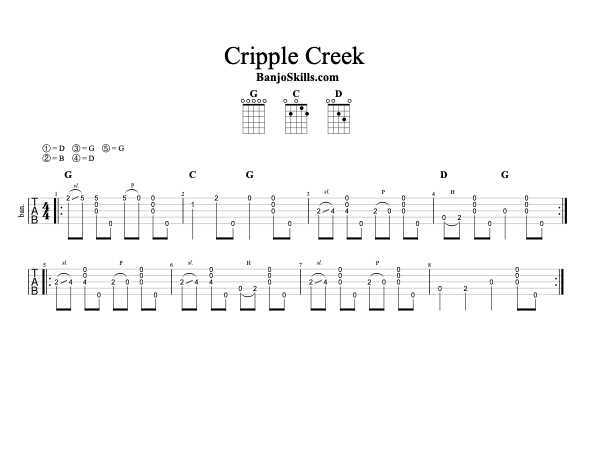
Get the Free Printable Cripple Creek Tab
Download a high-quality, printable PDF version of this tab — free. Keep it on your music stand or take it to your next jam session.
How to Play Cripple Creek - Step by Step
Get the Chord Progression Down
Before we touch the melody, let’s get comfortable with the chords. We’re in standard open G tuning (gDGBD), and the chord progression is nice and simple:
- A part: | G G | C G | G G | D G |
- B part: | G G | G G | G G | D G |
Practice switching between these three chords until the changes feel smooth. This is the foundation everything else hangs on.
Learn the Melody
The A part melody is simple and catchy. Play through it slowly a few times and try to commit it to memory. I always think the easiest way to learn and remember songs is to get that melody really concrete in your head. The rest is just filler, you don’t have to worry about it too much.
The B part melody has a different feel but stays in the same position on the neck. Same approach though: play it slowly, hum it to yourself, and get it under your fingers before moving on. Notice the B part sits on G for most of the progression, only moving to D right at the end.
Add the Bum-Ditty Rhythm
Once you have the melody, the next step is to superimpose that bum-ditty rhythm over it. Think about your 1-2-and-3-4-and pattern. If there’s no melody note on beats 2 or 4, you add a brush stroke and thumb pluck. If there is a melody note there, just add a thumb pluck after it.
This gives you a bare bones clawhammer arrangement, and honestly, it already sounds pretty cool at this point.
Embellish with Slides
Cripple Creek sounds really great with slides. It’s what gives the tune that bouncy, banjo-y feel. One of the easiest places to add slides is wherever you have an open second string. You can find that same note on the third string at the fourth fret, so you replace the open string with a slide from 2 to 4 on the third string.
Another great slide opportunity is right at the start. Slide from the 2nd fret to the 5th fret to kick things off. Listen to other versions of the song and you’ll hear this everywhere.
Add Pull-Offs
Look for spots where you’re going from a fretted note to an open note. Those are natural pull-off opportunities. In measure three of the A part, for example, you’ve got the second fret of the third string going to an open string. Easy pull-off.
Make It Your Own
These embellishments are suggestions, not rules. Feel free to break them, swap things around, and do whatever feels comfortable. As long as you have that melody intact, it’s going to sound good. That’s the beauty of clawhammer banjo: the melody is the anchor, and everything else is just decoration.
Practice Tips
- 1
Start by learning just the melody on its own, without any embellishments. Hum it, sing it, get it stuck in your head. The melody is the backbone of everything else you'll add later.
- 2
Practice the chord changes (G, C, D) slowly until they're smooth before trying to play the full arrangement. If the changes feel rough, your arrangement will too.
- 3
When adding slides, focus on the 2-to-4 slide on the third string. This one move replaces open second string notes and gives Cripple Creek that classic bouncy feel.
Frequently Asked Questions
What tuning is Cripple Creek played in?
Cripple Creek is played in standard open G tuning (gDGBD). This is the most common tuning for clawhammer banjo and the one you'll use for most beginner songs.
Is Cripple Creek a good song for beginners?
Absolutely. Cripple Creek is one of the first songs most clawhammer banjo players learn. It only uses three chords (G, C, and D), has a simple two-part structure, and sounds impressive even at a basic level.
What are the chords for Cripple Creek?
Just three chords: G, C, and D. The chord progression goes G-C-G-D-G for the A part, and a similar pattern for the B part. Very standard for old-time banjo songs.
What's the hardest part of Cripple Creek?
For most beginners, the B part feels trickier because the melody is a bit different from the A part. The slides and pull-offs can also take some practice. But the melody itself is straightforward, so take it slow and build up.
How do I make Cripple Creek sound better?
Start with the bare bones melody and bum-ditty rhythm, then layer in embellishments one at a time. Slides from the 2nd to 4th fret on the third string make a huge difference. Pull-offs add even more flavor. But honestly, even the basic version sounds great.