How to Play Cuckoo Bird on Banjo - Clawhammer Tab & Lesson
About This Song
Cuckoo Bird is such a fun song to play, and it's a song made for singing. It's one of those tunes that sounds fantastic whether you keep it simple or dress it up. It's got this dirty, grungy quality to it, and honestly, if you're not super precise with your right hand sometimes, it actually sounds pretty good in this song. That's part of the charm.
The song is a traditional folk tune of British origin that became one of the most beloved tunes in the Appalachian tradition. The earliest known versions date back to at least the late 1700s in Scotland. In the folk tradition, the cuckoo bird is a symbol of the coming of summer, but also of fickleness and false love. One of the most famous recordings was made by Clarence Ashley in 1929, and his version helped cement the song's place in old-time music. It remains a staple at old-time jams and festivals.
This arrangement is in sawmill tuning (gDGCD), which gives the song that dark, haunting quality that fits the lyrics perfectly. There are two parts: the instrumental solo (the between-verses break) and the vocal backup (a simplified version of the solo that stays out of the way while you sing). The melody is simple enough to learn quickly, and this version of the tab includes the Galax lick, so you get a taste of that classic old-time embellishmentation right out of the gate.
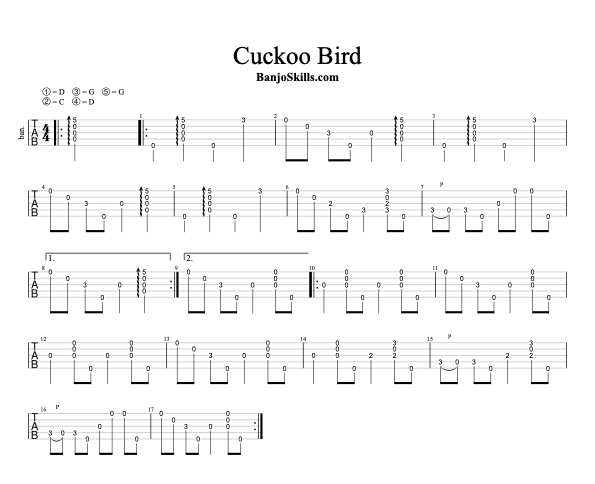
Cuckoo Bird Clawhammer Banjo Tab
Get the Free Printable Cuckoo Bird Tab
Download a high-quality, printable PDF version of this tab — free. Keep it on your music stand or take it to your next jam session.
How to Play Cuckoo Bird - Step by Step
Get Into Sawmill Tuning
Cuckoo Bird is played in sawmill tuning (gDGCD). If you are already in sawmill from playing a tune like Cluck Old Hen or Shady Grove, you are all set. If you are coming from standard open G tuning, the only change is raising your second string from B up to C. Everything else stays the same.
This is a song made for singing, so you want to get your banjo into a pitch that’s right for your voice. You might need to tune your whole banjo down a step or two to find a comfortable vocal range. The fingering doesn’t change at all, it just brings everything down to where you can sing along without straining.
Learn the Instrumental Solo
The instrumental solo is the between-verses part where the banjo takes the spotlight. This version of the tab uses the Galax lick, which is a classic clawhammer embellishment that pops up all over old-time music. It gives the tune extra rhythmic punch and that unmistakable old-time flavor.
The solo starts on the 5th fret of the first string with a Galax lick. From there, you move through the melody using a mix of fretted notes and open strings, with pull-offs adding smooth connections between phrases. The Galax lick weaves through the arrangement naturally, so you’ll pick it up as you learn the melody rather than having to bolt it on separately.
The instrumental solo has a first ending and a second ending, so you play through it once and take the first ending, then loop back and take the second ending the next time through. Practice that a bunch and get comfortable navigating both endings before moving on.
Learn the Vocal Backup
The vocal backup is really just a simplified version of the instrumental solo. Instead of all the Galax lick, you play an open string bum-ditty. You don’t even need your left hand for it. Just hit the third string and do a brush stroke.
You still keep that little descending phrase (open first, open second, third string at the third fret, open brush stroke), so it has the same overall shape as the solo. It’s just stripped down to stay out of the way while you sing. You do it twice, and then the third time you change it up the same way as the solo, fretting the second and third strings at the second fret before going into the pull-off on the fourth string.
Once you have both parts down, put them together. Play the instrumental solo, then sing a verse over the vocal backup, then go back into the solo. That’s the whole song.
Add the Pull-Offs
The tab includes pull-offs in several places, and they are worth spending some time on. A pull-off is where you fret a note, pluck the string, and then pull your fretting finger off to sound the open string below it. Done well, it creates a smooth, flowing connection between two notes.
In this arrangement, you will see pull-offs in both the instrumental solo and the vocal backup. They tend to appear on the 3rd fret pulling off to open on the fourth string, which adds a nice embellishment to the descending phrase.
The key to a good pull-off is the pulling motion. Do not just lift your finger straight up. Instead, pull it slightly downward (toward the floor) as you release. This gives the open string enough energy to ring out clearly. Practice each pull-off spot in isolation before plugging it back into the full tune.
About the Galax Lick
The tab for this arrangement already includes the Galax lick, so you’re learning it as part of the tune. The Galax lick is a classic clawhammer banjo embellishment that shows up all over old-time music, named after Galax, Virginia, a hub of old-time playing. It adds rhythmic punch and that unmistakable old-time flavor. If you’ve never played the Galax lick before, Cuckoo Bird is a great place to get it under your fingers because the melody is simple enough that you can focus on nailing the lick without getting overwhelmed.
Make It Your Own
Cuckoo Bird is kind of a dirty, grungy song, and you can lean into that. Simple sounds fantastic here. If any part feels too tricky right now, switch it out for some open strums. That’s okay. You know the framework of the song, and you can play with that in any way you want to make it easier or as hard as you want.
Once you are comfortable with the basic arrangement, experiment. Try adding pull-offs in places where they are not written, or leave some out if you prefer a cleaner sound. Listen to different recordings of the song and pick up ideas from other players. The melody is the anchor, and as long as you keep that intact, everything else is fair game.
Practice Tips
- 1
Learn the instrumental solo first and play it on a loop until it feels natural. The Galax lick is built right into the arrangement, so you'll internalize it just by learning the tune. Once the solo is solid, the vocal backup will feel easy by comparison.
- 2
When you hit the pull-off, keep it clean and deliberate. Pull slightly downward rather than just lifting your finger. A weak pull-off will sound dead and lifeless, so practice each one in isolation until it rings out clearly.
- 3
This is a song that sounds great even when you simplify it. If any part feels too tricky right now, switch it out for some open string bum-ditties. Don't let the fancy stuff hold you back from playing and singing it.
Frequently Asked Questions
What tuning is Cuckoo Bird played in?
Cuckoo Bird is played in sawmill tuning (gDGCD). That's the same as standard open G except the second string goes up from B to C. This tuning gives the song its dark, modal character.
Is Cuckoo Bird a good song for beginners?
Yes. The melody is straightforward, and the structure is clear with an instrumental solo and a vocal backup. If you already know another sawmill tuning song like Cluck Old Hen or Shady Grove, the tuning will feel familiar. And even if your right hand isn't super precise yet, this song sounds great a little rough around the edges.
What techniques does Cuckoo Bird use?
This arrangement uses pull-offs, alternate string pull-offs, drop thumb, and the Galax lick. The Galax lick is a classic clawhammer embellishment that adds rhythmic punch and old-time flavor. Pull-offs appear in several spots and add a smooth, flowing connection between notes. The overall arrangement is straightforward, which makes it a great tune for getting comfortable with these techniques.
What is sawmill tuning?
Sawmill tuning is gDGCD. Starting from standard open G tuning (gDGBD), you raise the second string from B up to C. It is one of the most common alternate tunings in clawhammer banjo and gives tunes a darker, modal sound.
How is Cuckoo Bird structured?
The song has two parts. The instrumental solo is the between-verses break where the banjo takes the spotlight. It has a first ending and a second ending, so you play through it twice with a slightly different resolution each time. The vocal backup is a simplified version of the solo that stays out of the way while you sing. You alternate between the two: solo break, then sing a verse with the vocal backup, then solo break again.