How to Play Darling Cora on Banjo - Clawhammer Tab & Lesson
About This Song
Darling Cora (also known as Darlin' Corey) is one of those haunting mountain songs that just gets under your skin. It's been part of the Appalachian tradition for a long time, and you'll hear it at old-time gatherings everywhere. If you're familiar with Little Maggie, this one lives in similar territory.
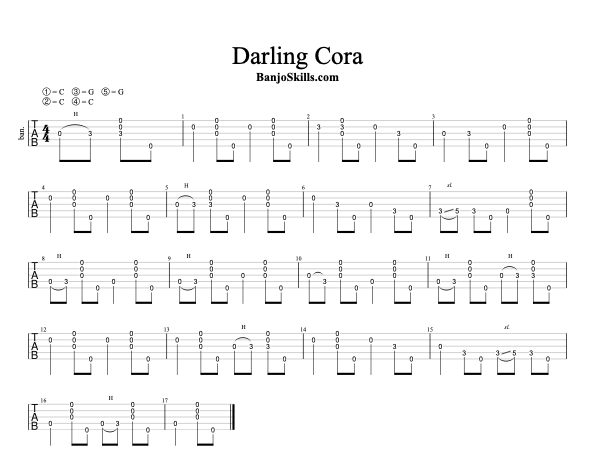
This arrangement is in Triple C tuning (gCGCC), which gives the banjo a deep, droning sound that suits the song's modal character perfectly. The tune has a haunting, repetitive quality that lends itself beautifully to the clawhammer style. If you've been wanting to explore modal tunings and get that dark, droning sound, Darling Cora is a great place to start.
Darling Cora Clawhammer Banjo Tab
Get the Free Printable Darling Cora Tab
Download a high-quality, printable PDF version of this tab — free. Keep it on your music stand or take it to your next jam session.
How to Play Darling Cora - Step by Step
Get Into Triple C Tuning
Before you play a single note of the melody, you need to retune your banjo. Triple C tuning is gCGCC (5th string to 1st). Starting from standard Open G (gDGBD):
- Lower your 1st string from D down to C
- Raise your 2nd string from B up to C
- Lower your 4th string from D down to C
- The 3rd and 5th strings stay where they are
Once you’re in tune, strum the open strings and listen. You’ll hear a deep, open, droning sound. That’s the foundation of this entire arrangement. Spend a minute just strumming and getting your ear adjusted to this new sonic landscape.
Feel the Modal Sound
Darling Cora is a modal tune, which means it doesn’t follow the usual major or minor chord patterns you might be used to. There are no chord changes marked in the tab because the whole song lives in one tonal world. The open strings drone underneath while the melody moves on top.
This is one of the things that makes old-time banjo so distinctive. You’re not thinking in terms of chord progressions here. Instead, you’re playing a melody against a constant, buzzing backdrop of open strings. Let those open strings ring. They’re not filler. They’re the sound of the tune.
Work Through the First Half
The tune is 18 measures long in 4/4 time. Start with the first 8 measures and work through them slowly. The melody sits primarily on the upper strings while the open strings provide the drone underneath.
Watch for the hammer-ons marked with an H in the tab. These are the main embellishment throughout the arrangement and they give the tune its driving, rhythmic energy. Each hammer-on should snap clearly. If the hammered note is weak or muffled, focus on bringing your finger down with more force and precision.
The melody has a repetitive, hypnotic quality. Certain phrases come back again and again with small variations. This is typical of modal tunes and is part of what makes them so compelling. Don’t fight the repetition. Lean into it.
Work Through the Second Half
The second half develops the same melodic ideas with small variations. The closing measures bring the tune to its conclusion with a final resolution. Pay attention to how the melody winds down and settles back into the drone of the open strings. That sense of coming home is important to the feel of the tune.
Focus on the Groove
Modal tunes like Darling Cora live and die by their groove. Once you have the notes down, shift your attention to feel and timing. The bum-ditty pattern in 4/4 time creates a steady, driving pulse. Every note should lock into that pulse.
The tune has a forward momentum to it. It doesn’t sit still. The hammer-ons push the rhythm forward, and the drone strings keep everything grounded. Finding that balance between forward motion and steady pulse is the heart of playing this kind of tune.
Make It Your Own
Once the arrangement is solid, experiment with dynamics. You can accent certain melody notes to bring out the vocal line, or let certain passages get quieter before building back up. The repetitive structure of the tune gives you room to play with light and shade without changing any notes. That’s one of the beautiful things about modal music. Small changes in touch and dynamics can completely transform the feel.
Practice Tips
- 1
Get comfortable with Triple C tuning before diving into the melody. Strum the open strings and listen to how the tuning sounds different from Open G. That open, droning quality is the whole foundation of this arrangement.
- 2
Focus on the hammer-ons first in isolation. They drive the rhythmic pulse of the tune, and getting them crisp and in time will make everything else fall into place.
- 3
Lean into the repetition. The melody comes back to the same phrases again and again. Let those repeats sit in the pocket instead of trying to make each one different.
Frequently Asked Questions
What tuning is Darling Cora played in?
This arrangement uses Triple C tuning, where the strings are tuned gCGCC (from 5th string to 1st). To get there from standard Open G, lower your 1st string from D to C, raise your 2nd string from B to C, and lower your 4th string from D to C. The 3rd and 5th strings stay the same.
Is Darling Cora hard to play on banjo?
It's an intermediate tune. The melody itself is not overly complex, but playing in Triple C tuning is a new experience if you've only played in Open G. The modal sound can feel unfamiliar at first, and the hammer-ons require solid technique. If you're comfortable with basic clawhammer and want to branch out into alternate tunings, this is a great next step.
What is Triple C tuning?
Triple C tuning (gCGCC) gets its name from having three strings tuned to C. From standard Open G tuning, you lower the 1st, 2nd, and 4th strings each down to C. This creates a rich, droning sound with a distinctly modal flavor. It's popular for songs like Darling Cora, Little Maggie, and other mountain tunes with a darker mood.
What is the difference between Darling Cora and Little Maggie?
Darling Cora and Little Maggie are closely related songs that share similar themes of love, loss, and moonshine. They come from the same Appalachian folk tradition and are sometimes confused with each other. The melodies are different, though, and they are considered separate songs. Both work well in modal tunings on the banjo.
What techniques are used in this arrangement?
The arrangement is built around hammer-ons. They drive the rhythmic pulse and appear frequently throughout the tune. There's no drop thumb or pull-offs in this particular arrangement, keeping the focus on the melody and the modal drone.