How to Play Ducks on the Millpond on Banjo - Clawhammer Tab & Lesson
About This Song
Ducks on the Millpond is a classic old-time fiddle tune that just drives. The energy is infectious, and once you get it rolling, it's hard to stop playing. You'll hear it at old-time jams everywhere.
This arrangement is in Double C tuning (gCGCD) and captures that driving, rhythmic energy that makes this tune so much fun. It features slides, hammer-ons, pull-offs, and triplet figures, making it a great workout for intermediate players looking to level up their technique. There's a lot going on here, but it all fits together naturally once you take it piece by piece.
Ducks on the Millpond Clawhammer Banjo Tab
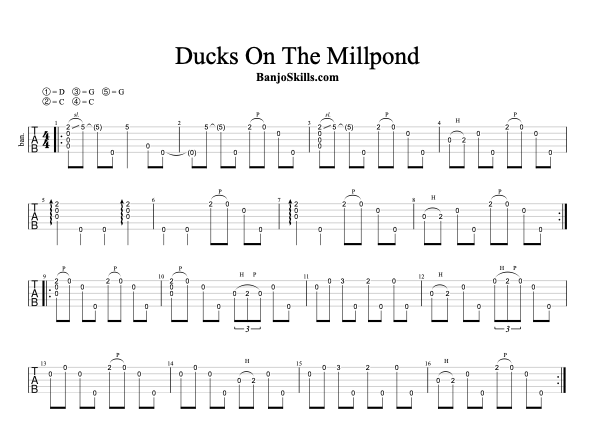
Get the Free Printable Ducks on the Millpond Tab
Download a high-quality, printable PDF version of this tab — free. Keep it on your music stand or take it to your next jam session.
How to Play Ducks on the Millpond - Step by Step
Get Into Double C Tuning
Ducks on the Millpond is played in Double C tuning (gCGCD). From standard Open G (gDGBD), you need to change two strings:
- Lower your 4th string from D down to C
- Raise your 2nd string from B up to C
Your 1st string stays at D, 3rd at G, and 5th at G. The name “Double C” comes from having two C strings (the open 2nd and open 4th). Strum the open strings and listen to the sound. It has a bright, open quality compared to Open G, and those two C strings create a natural drone that suits this tune perfectly.
Learn the A Part
The arrangement has two distinct sections. The A part runs through the first half of the tune and establishes the main melody. Start here and take it slowly, a few measures at a time.
Right from the opening measures, you’ll notice slides (marked S in the tab). These slides are a defining feature of the tune. They give the melody a fluid, connected feel. Each slide should be smooth and controlled. Press the string firmly and glide to the target fret without lifting pressure.
You’ll also encounter pull-offs (marked P) in the A part. A good pull-off snaps the string as you release the fret. Don’t just lift your finger straight up. Pull it slightly downward (toward the floor) as you release. This gives the open string enough energy to ring clearly.
Learn the B Part
The B part introduces new melodic material and shifts the energy of the tune. This is where the arrangement gets more technically demanding. You’ll find hammer-ons (marked H) joining the slides and pull-offs from the A part.
The most distinctive feature of the B part is the triplet figures, marked with a bracket and the number 3 in the tab. Triplets squeeze three notes into the space normally occupied by two. They create a burst of rapid-fire notes that add excitement and drive to the melody. Practice these triplets in isolation. Count them as “trip-a-let” and make sure all three notes are even in volume and timing.
Connect the Sections
Once you can play each part individually, start connecting them. Play through the A part and go directly into the B part without stopping. The transition between sections is where most players stumble, so pay extra attention to the last measure of the A part leading into the first measure of the B part.
The arrangement has repeat signs, so each part gets played twice before moving on. A-A-B-B is the standard structure. Practice playing through the full form: A part twice, B part twice, and then loop back to the beginning.
Build Up the Speed
This is a tune that sounds great at a moderate tempo, but it really comes alive when you push the speed a bit. Start slow with a metronome and gradually increase the tempo over several practice sessions. Don’t jump ahead. If any section falls apart at a higher speed, drop back down and clean it up before trying again.
Pay attention to your right hand as you speed up. The bum-ditty pattern should stay relaxed and consistent even as the left hand gets busier with slides, hammer-ons, and pull-offs. If your right hand starts tensing up, that’s a sign you’ve pushed the tempo too far too fast.
Make It Your Own
Ducks on the Millpond is the kind of tune that rewards repetition. The more you play it, the more natural the embellishments become, and the more room you have to play with dynamics and feel. Try accenting the first beat of each measure to emphasize the driving pulse. Experiment with playing certain passages louder or softer. The tune has a built-in energy to it. Your job is to channel that energy and ride it.
Practice Tips
- 1
Isolate the triplet figures (marked with a 3 bracket in the tab) and practice them on their own. These are the trickiest spots in the arrangement, and getting them smooth at a slow tempo will pay off when you speed up.
- 2
Work on the pull-offs until they ring out clearly. A pull-off should snap the string, not just lift off of it. Practice pulling slightly downward as you release the fret to get a clean, strong note.
- 3
Practice the A part and B part separately until each one is solid before connecting them. The transitions between sections are where most mistakes happen, so spend extra time on the last measure of each part going into the first measure of the next.
Frequently Asked Questions
What tuning is Ducks on the Millpond played in?
This arrangement is in Double C tuning (gCGCD). From standard Open G, lower your 4th string from D to C and raise your 2nd string from B up to C. The two open C strings (2nd and 4th) give the tuning its name. Your 1st string stays at D, 3rd at G, and 5th at G.
Is Ducks on the Millpond hard to play on banjo?
It's an intermediate tune. The melody is catchy and memorable, but the arrangement includes slides, hammer-ons, pull-offs, and triplet figures that require solid clawhammer technique. If you're comfortable with basic tunes and want a challenge that will push your skills forward, this is a great choice.
What techniques are used in this arrangement?
The arrangement uses four main techniques beyond basic clawhammer playing: slides (marked S), hammer-ons (H), pull-offs (P), and triplets (marked with a bracket and the number 3). These embellishments work together to create the driving, rhythmic feel that defines the tune.
Can I play Ducks on the Millpond in Open G tuning?
You could adapt it, but the tune really benefits from Double C tuning. The open C strings provide a natural drone that matches the key of the melody, and certain passages in the tab rely on open strings that only work correctly in Double C. For the best results, take the time to retune.