How to Play Pretty Polly on Banjo - Clawhammer Tab & Lesson
About This Song
Pretty Polly is one of the most well-known murder ballads in the Appalachian folk tradition. The song traces its roots back to an English broadside ballad from the 1700s called "The Gosport Tragedy" (also known as "The Cruel Ship's Carpenter"). In the original version, a ship's carpenter seduces a young woman, promises to marry her, and then murders her. When the ballad crossed the Atlantic and settled into the Appalachian Mountains, it shed some of the original details but kept the core of the story. In the American version, a man named Willie lures Polly into the woods with promises of marriage, where a freshly dug grave is waiting.
What makes Pretty Polly so haunting is not just the story but the way the music reinforces it. Played in sawmill tuning, the song never quite resolves to major or minor. It just sits in this tense, unsettled space that mirrors the dread of the narrative. Some of the most memorable recordings come from Dock Boggs and Ralph Stanley, both of whom brought their own intensity to the song. This arrangement uses a capo at the 2nd fret to bring the pitch up, and the result is a sound that really cuts through.
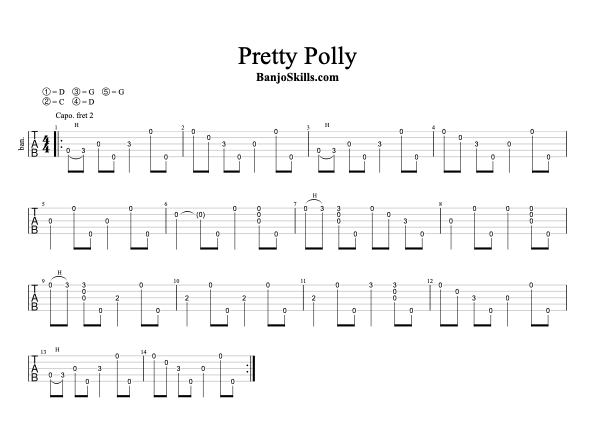
Pretty Polly Clawhammer Banjo Tab
Get the Free Printable Pretty Polly Tab
Download a high-quality, printable PDF version of this tab — free. Keep it on your music stand or take it to your next jam session.
How to Play Pretty Polly - Step by Step
Get Into Sawmill Tuning and Add the Capo
Pretty Polly is played in sawmill tuning (gDGCD) with a capo at the 2nd fret. If you’re in standard open G, the only change is tuning your second string up from B to C. Once you’re in sawmill, place your capo at fret 2 and tune your 5th string up to an A.
Strum the open strings and listen. You’ll hear that dark, modal sound that sawmill tuning is known for, but with a slightly higher pitch thanks to the capo. This is the sound that makes Pretty Polly so eerie. Your brain wants the song to resolve to either major or minor, and it never does. That unresolved tension is baked right into the tuning.
Learn the First Section
The first section of the tab covers measures 1 through 8. This is where you’ll get the core melody and feel of the song under your fingers. Play through it slowly, measure by measure.
You’ll notice hammer-ons appearing right from the start. These are marked with an “H” in the tab. The hammer-ons give the melody its forward motion and add a rhythmic snap that keeps things from sounding flat. Make sure each hammer-on rings out cleanly. Fret the target note with authority.
Learn the Second Section
Measures 9 through 14 make up the second section, and this is where the arrangement opens up a bit. You’ll find the melody moving around more, with some different intervals and a slightly different feel.
The hammer-ons continue here, and the rhythmic patterns shift in ways that add interest. Take each measure on its own before stringing them together. The repeat sign at the end of the tab tells you this whole arrangement loops, which makes sense for a song with multiple verses.
Nail the Hammer-Ons
Hammer-ons are the main technique in this arrangement, and getting them right is what separates a flat-sounding version from one that has life in it. When you see an “H” in the tab, you’re fretting a note by bringing your finger down hard enough onto the string that it sounds without being picked.
The key is commitment. A timid hammer-on will barely register. You want to come down right behind the fret with enough force that the note speaks clearly. Practice the hammer-on spots in isolation if they’re giving you trouble. Play just the measure with the hammer-on, slowly, until it feels natural and the note rings out every time.
Work on the Feel
Pretty Polly is a song where feel matters as much as the notes. This is a murder ballad, and it should sound like one. Play it at a deliberate, unhurried tempo. Let the notes ring. Leave space where the melody breathes.
Think about dynamics too. You don’t have to play every note at the same volume. Letting certain notes come through louder while others drop back creates a sense of tension and release that fits the mood of the song perfectly. The sawmill tuning is already doing a lot of the atmospheric work for you. Your job is to lean into that and not fight it.
Make It Your Own
Once you’ve got the arrangement down, start thinking about how you want to perform it. If you’re singing, you might want to simplify certain measures to give the vocal room. If you’re playing it as an instrumental, you can lean into the hammer-ons and let the banjo be the storyteller.
Pretty Polly has been sung and played for hundreds of years, and every musician who picks it up adds something of themselves to it. Try different tempos. Experiment with how much space you leave between phrases. Listen to Dock Boggs, Ralph Stanley, and other versions to hear how different artists approached the same song. Then find your own way in.
Practice Tips
- 1
Start by getting comfortable with the capo at fret 2 in sawmill tuning. The fret spacing feels tighter up there, and your hand position will be a little different than playing open position. Strum through some open strings and get your bearings before diving into the tab.
- 2
Focus on the hammer-ons. They show up throughout this arrangement and they're what give Pretty Polly its forward momentum. Make sure you're hammering on with enough force that the note rings out clearly, not just ghosting it.
- 3
Play this one slowly and let the notes breathe. Pretty Polly is not a tune you rush through. The mood of the song comes from that dark, unresolved sawmill sound, and you lose all of that if you speed it up too much.
Frequently Asked Questions
What tuning is Pretty Polly played in?
Pretty Polly is played in sawmill tuning (gDGCD) with a capo at the 2nd fret and the 5th string tuned up to A. To get into sawmill from standard open G, tune your second string up from B to C. Then place your capo at fret 2 and tune your 5th string up to an A. The capo raises the pitch but doesn't change any of the fingering.
Why does Pretty Polly use a capo?
The capo at the 2nd fret raises the overall pitch of the song, which suits the melody and vocal range well. It also gives the banjo a brighter, more cutting tone that works perfectly for a murder ballad. All the tab fingerings are written relative to the capo, so you read them the same way you would without a capo.
How hard is Pretty Polly to play?
It's an intermediate tune, but it's on the approachable end of intermediate. If you've got the basic clawhammer bum-ditty pattern down and you're comfortable in sawmill tuning, you can handle this one. The main technique to watch for is the hammer-ons that appear throughout the arrangement.
What's the connection between Pretty Polly and The Gosport Tragedy?
Pretty Polly evolved from The Gosport Tragedy, an English broadside ballad from the 1700s. The original told the story of a ship's carpenter who murders a young woman. When the song traveled to Appalachia, the setting changed from the sea to the woods, the carpenter became a man named Willie, and many of the supernatural elements were stripped away. The core of the story, a woman lured to her death by a man she trusted, stayed the same.