How to Play Rain and Snow on Banjo - Clawhammer Tab & Lesson
About This Song
Rain and Snow is a classic sawmill tune and a lot of fun to play. You might know it from the Grateful Dead, and there are a lot of people that have played this song over the years. I really like Molly Tuttle's version as well. But the version we've based our arrangement on is Obray Ramsey's, a really nice take on the tune.
The song is a traditional Appalachian folk song that first appeared in print in Campbell and Sharp's 1917 collection, English Folk Songs from the Southern Appalachians, collected from Mrs. Tom Rice in Big Laurel, North Carolina in 1916. Obray Ramsey recorded it in 1961, and that version later inspired the Grateful Dead's well-known rendition, which introduced it to a much broader audience.
This arrangement is an instrumental in sawmill tuning, tuned down a half step. It makes heavy use of m-skips, hammer-ons, slides, and alternate string pull-offs. It's an intermediate arrangement with some genuinely fun passages that will challenge your timing and reward your patience.
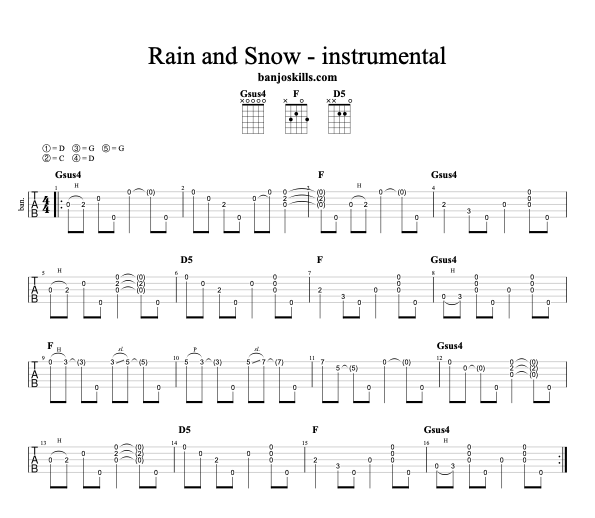
Rain and Snow Clawhammer Banjo Tab
Get the Free Printable Rain and Snow Tab
Download a high-quality, printable PDF version of this tab — free. Keep it on your music stand or take it to your next jam session.
How to Play Rain and Snow - Step by Step
Get Into Sawmill Tuning (Tuned Down)
Rain and Snow is played in sawmill tuning, but tuned down a half step from standard. Regular sawmill tuning is gDGCD (fifth string to first). For this arrangement, you’ll tune everything down a half step, giving you F#-C#-F#-B-C#.
If you’re already familiar with sawmill tuning from tunes like Shady Grove, you’re halfway there. Just bring each string down a half step. Use a tuner to make sure you’re accurate. Your fretting hand shapes stay exactly the same. The lower pitch gives the tune a slightly darker, heavier sound that really suits the mood of the song.
Learn the Chord Shapes
This arrangement uses three chords: Gsus4, F, and D5. You can see the chord diagrams at the top of the tab. The Gsus4 is your home base. You’ll spend most of the tune sitting on that shape. The F chord appears as a contrast, and D5 shows up briefly in the second and fourth lines.
The progression moves like this:
- Lines 1 and 2: | Gsus4 | F | Gsus4 | D5 | F | Gsus4 |
- Line 3: | F | F | Gsus4 |
- Line 4: | D5 | F | Gsus4 |
Get comfortable switching between these three shapes before you start working on the melody. The chord changes are the roadmap for the whole tune.
Work Through the Melody Line by Line
The arrangement is four lines long and each line has its own character. Lines one and two lay down the main melodic theme. Line three builds intensity with a steady m-skip pattern. Line four is essentially the same as line two, so once you’ve got line two down, you’ve already learned the ending.
Play through each line slowly and focus on getting the notes clean. Don’t worry about speed or feel yet. Just the notes. Once you can play each line on its own without stumbling, start connecting them. Play lines one and two back to back, then add line three, then finish with line four.
Master the M-Skips
This tune makes heavy use of m-skips, and they’re a big part of what gives it that distinctive rhythmic feel. An m-skip is where you skip the brush stroke in the bum-ditty pattern. You make your normal clawhammer downstroke motion but miss the strings entirely, then pluck up with your thumb on the fifth string as usual.
If you count it out slowly, it goes: one and skip and three and skip and. On the m-skip beats, the “two” (or wherever the skip falls) is silent. Your arm keeps moving, your thumb still plucks, but there’s a gap that creates space and syncopation.
Line three is where the m-skips really shine. There’s a steady pattern of m-skips combined with hammer-ons and slides that sounds great once you get it locked in. Take this line slowly and count it out until it clicks.
Add the Embellishments
You’ll find hammer-ons, slides, and alternate string pull-offs throughout this arrangement. The hammer-ons are straightforward and appear frequently. You’ll also see slides marked in the tab, particularly in line three, where they add a smooth, vocal quality to the melody.
The alternate string pull-off in measure two is worth some extra attention. You strike the second string with your index finger while fretting the first string at the second fret, then pull off on the first string. It’s a quick, fluid motion that creates a nice melodic turn. Practice this move in isolation until it feels natural.
Drop thumb also shows up in this arrangement, adding rhythmic drive in spots where the melody dips to the lower strings. Keep your clawhammer motion steady and let the drop thumb feel like a natural extension of your picking pattern.
Make It Your Own
Rain and Snow is a tune with a lot of room for personal expression. Once you’re comfortable with the arrangement as written, experiment with where you place the m-skips or how aggressively you attack the slides. Maybe you simplify a measure that feels too busy, or maybe you find a spot where adding an extra hammer-on sounds right to your ear.
The syncopation is what makes this tune special. It has a push-and-pull quality that keeps it from ever feeling too predictable. Lean into that. Let the rhythm breathe. And don’t rush it. This is a tune that sounds best when it has space to settle into its groove.
Practice Tips
- 1
Use your arm as a metronome. This arrangement is syncopated in places, and keeping a steady clawhammer motion will help you stay on beat even when the melody feels like it's pulling against the rhythm.
- 2
Isolate line three. That's where the m-skip and slide pattern gets dense. Loop those measures slowly with a metronome until the pattern feels automatic, then reconnect it with the rest of the tune.
- 3
Practice the alternate string pull-offs on their own before plugging them into the full arrangement. Get the motion smooth at a slow tempo, then gradually speed it up. Once it feels natural in isolation, it'll slot right in.
Frequently Asked Questions
What tuning is Rain and Snow played in?
Rain and Snow is played in sawmill tuning (gDGCD), tuned down a half step. That puts the actual pitches at F#-C#-F#-B-C#. Your fretting hand shapes stay the same as regular sawmill, everything just sounds a half step lower.
What chords does Rain and Snow use?
This arrangement uses three chords: Gsus4, F, and D5. In the context of sawmill tuning tuned down a half step, these are the chord shapes you'll be working with throughout the tune.
Is Rain and Snow hard to play on banjo?
It's an intermediate tune. If you're comfortable with basic sawmill tunes like Shady Grove, you're ready to tackle this one. The syncopation, m-skips, and slides add challenge, but the melody is logical and the chord progression is straightforward.
What are m-skips and why are they used in this song?
An m-skip is when you skip the brush stroke in the bum-ditty pattern and just play the melody note followed by the thumb pluck. Rain and Snow uses a lot of m-skips to create a lighter, more open sound that gives the tune its distinctive rhythmic feel.
What's the difference between this version and the Grateful Dead version?
This is a clawhammer banjo instrumental arrangement based on the traditional Obray Ramsey style. The Grateful Dead version is a full-band arrangement with vocals. The melody is related, but this instrumental version has its own character and feel that suits the banjo beautifully.