How to Play Sally in the Garden on Banjo - Clawhammer Tab & Lesson
About This Song
Sally in the Garden is a classic old-time tune that you'll hear at jams everywhere. It's one of those tunes that every region and every musician puts their own spin on, which is part of what makes old-time music so alive.
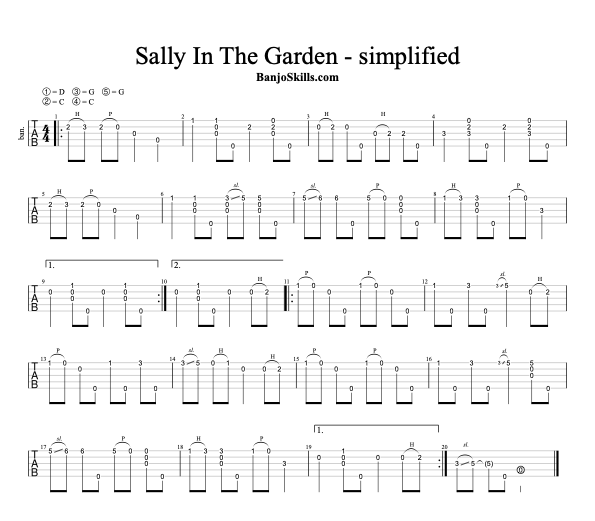
On the banjo, Sally in the Garden lives in Double C tuning and has a darker, more driving feel than a lot of tunes in this tuning. This arrangement features hammer-ons, pull-offs, and slides throughout, which lean into that intensity. The more advanced version shown in the video also uses harmonics as an embellishment, adding an eerie shimmer that fits the tune's character perfectly. You'll get that full arrangement when you download the PDF tab.
Sally in the Garden Clawhammer Banjo Tab
Get the Free Printable Sally in the Garden Tab
Download a high-quality, printable PDF version of this tab — free. Keep it on your music stand or take it to your next jam session.
How to Play Sally in the Garden - Step by Step
Get Into Double C Tuning
Sally in the Garden is in Double C tuning (gCGCD). If you’re coming from standard open G, you need to change two strings: drop the fourth string from D down to C, and raise the second string from B up to C. Strum the open strings and make sure everything sounds right before diving in.
Understand the Structure
This arrangement has two main parts with repeat signs. The A part has first and second endings, meaning you play it through once, go back to the beginning, and then take a different ending the second time. The B part follows a similar structure. Pay attention to those repeat signs and endings in the tab so you know where you’re going.
Work Through the A Part
The A part opens with a melody that moves between fretted notes and open strings. You’ll see hammer-ons (marked H) and pull-offs (marked P) from the very first line. These embellishments aren’t just decoration here. They’re woven into the melody itself.
Take the first couple of measures and get them comfortable before moving on. The hammer-ons in this section should snap cleanly. If they’re buzzing or not ringing out, slow down and focus on landing your fretting finger right behind the fret wire.
Watch for the first and second endings. The first time through the A part, you take the first ending and loop back. The second time, you skip to the second ending and move on to the B part.
Dig Into the B Part
The B part has a different character. You’ll see slides (marked sl) appearing here alongside the hammer-ons and pull-offs. The slides add a smooth, vocal quality to the melody that contrasts nicely with the snappier hammer-ons.
When you hit a slide, aim for a smooth, even motion from the starting fret to the target fret. Don’t rush it. The slide should take up a defined amount of rhythmic space, not just be a blur between two notes.
Layer in the Embellishments
If the full arrangement feels overwhelming, strip it back. Play the melody with a basic bum-ditty rhythm first, leaving out the hammer-ons, pull-offs, and slides. Once the melody is solid in your hands and your head, start adding the embellishments back in one at a time. Hammer-ons first, since there are the most of them, then pull-offs, then slides.
Make It Your Own
Sally in the Garden is a tune that invites variation. Once you have this arrangement down, try mixing up where you use embellishments and where you keep things simple. Play it stripped down for a verse, then add all the fancy stuff for the next one. That kind of contrast is what keeps old-time tunes alive and interesting, and it’s a lot more musical than playing the same thing on repeat.
Practice Tips
- 1
Practice the hammer-ons in isolation before putting them into context. There are a lot of them in this arrangement, and each one needs to ring out clearly to keep the tune sounding crisp.
- 2
Pay close attention to the slides, especially in the B part. A smooth slide that lands right on the target fret makes a huge difference in how polished the tune sounds.
- 3
Work the first and second endings separately. The repeat signs in the A part mean you play it twice, but the ending changes the second time through. Make sure you know which ending goes where before you try to play the full tune.
Frequently Asked Questions
What tuning is Sally in the Garden played in?
Sally in the Garden is played in Double C tuning (gCGCD). From standard open G, drop your fourth string from D to C and raise your second string from B to C.
Is Sally in the Garden hard to play on banjo?
This arrangement is intermediate level. The melody itself is straightforward, but the hammer-ons, pull-offs, and slides throughout the tab require some experience with embellishments. If you're comfortable with beginner Double C tunes like Old Molly Hare, this is a natural next step.
What techniques do I need for this arrangement?
You'll use hammer-ons, pull-offs, and slides throughout this arrangement. The hammer-ons are the most frequent technique, appearing in nearly every line. If you're newer to these embellishments, practice each one in isolation before working them into the full tune.