How to Play Silent Night on Banjo - Clawhammer Tab & Lesson
About This Song
Silent Night is a lush, beautiful Christmas tune. It was written more than 200 years ago in Austria as "Stille Nacht, heilige Nacht". In 2011, UNESCO declared it an intangible cultural heritage. And it's a blast to play on the banjo.
Silent Night Clawhammer Banjo Tab
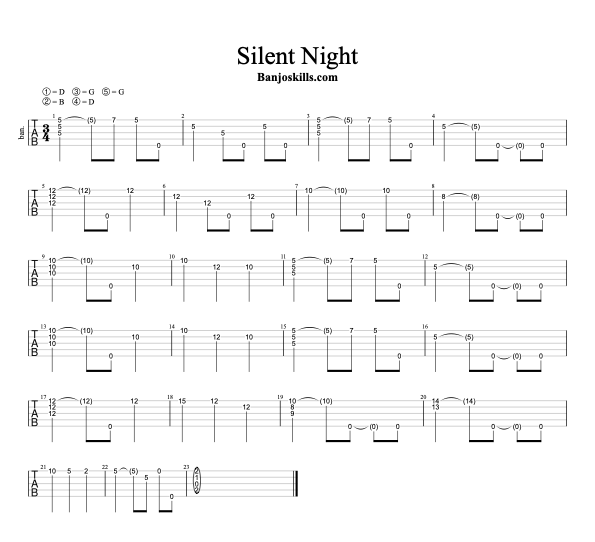
Get the Free Printable Silent Night Tab
Download a high-quality, printable PDF version of this tab — free. Keep it on your music stand or take it to your next jam session.
How to Play Silent Night - Step by Step
Check Your Setup First
Before you start learning the arrangement, take a minute to check your bridge position. This matters more for this song than for most tunes because we’ll be playing all the way up to the 12th fret and beyond. Fret a string at the 12th fret and compare it to the open string. They should be the same note, one octave apart. If they’re not, your intonation is off and everything up the neck will sound wrong. Adjust your bridge until it’s right.
We’re in standard open G tuning (gDGBD). No retuning needed for this one.
Get Comfortable with 3/4 Time
Silent Night is in 3/4 time, which is waltz time. If you’ve been playing mostly old-time tunes, you’re used to 4/4, where the basic clawhammer pattern is bum-ditty. In 3/4, the pattern becomes bum-ditty-ditty. Three beats per measure instead of two.
Before you touch the tab, just practice that rhythm on open strings. Count “one-two-three, one-two-three” and feel that waltz pulse. It’s a different groove than what you’re used to, and it needs to feel natural before you start adding melody notes and chord shapes on top of it.
Work on Bar Chords
Bar chords are the backbone of this arrangement. You’ll be barring across the strings at several positions up the neck, and if you can’t get a clean bar chord, the song won’t come together.
Here’s the technique: lay your index finger flat across all the strings at the fret. Use your thumb on the back of the neck as a counterpoint for leverage. Roll your index finger slightly toward the bony edge rather than pressing with the soft pad. That bony edge gives you a flatter surface and more consistent pressure across the strings.
Start at the 5th fret and practice barring until every string rings cleanly. Then try the same thing at the 12th fret. The frets are closer together up there, so it feels a little different. Get comfortable in both positions before moving on.
The 5th Fret Position
The arrangement opens with a bar chord at the 5th fret. This is where the melody begins. Work through this section of the tab slowly, paying attention to the melody notes that sit on top of the bar chord shape.
Moving Up to the 12th Fret
Next, the bar chord moves up to the 12th fret. This is the same shape you were playing at the 5th fret, just higher on the neck. Use the double dot markers at the 12th fret as your landmark.
The melody continues to unfold over the bar chord, and you’ll hear it start to open up as the notes ring in that higher register. Take it measure by measure. The left hand position is the same concept as the 5th fret section, just in a different location on the neck.
Navigate the Tricky Transitions
This is where the arrangement gets challenging. There are measures where you need to break out of the bar chord and place individual fingers at different frets. For example, you’ll find spots where your ring finger and index finger need to be on different strings at different frets while the bar chord is released.
The key here is to know where you’re going before you get there. Look ahead in the tab and visualize the next hand position while you’re still playing the current one. Use the dot markers on the neck to orient yourself. The dots at the 5th, 7th, 10th, and 12th frets are your road signs.
Go slowly through these transitions. Speed is not the goal. Clean, accurate position changes are. If a particular transition is giving you trouble, isolate it. Play just the last beat of the measure before and the first beat of the measure after, back and forth, until the shift feels smooth.
M-skips
Throughout the tab, you’ll see notes in parentheses. These are M-skips. The easiest way to think about them is that you’re “skipping” the brush stroke. Your clawhammer motion remains the same, but instead of going for the “dit” of your bum-ditty, you’re just going to move your fingers past the strings.
M-skips are a big part of what makes this arrangement work. Instead of always brushing across the strings, you’re isolating individual notes within the bar chord and letting them sustain. This gives the song its gentle, flowing character. Your right hand keeps doing the same clawhammer stroke as always. The difference is all in the left hand. Don’t lift your left hand fingers too early. Keep them pressed down and let those notes ring out and overlap with the notes that come after. The beauty of Silent Night comes from those layered, sustained tones.
Put It All Together
Once you have each section under your fingers, start connecting them. Play through the whole arrangement at a slow, steady tempo. Don’t speed up through the easy parts and slow down through the hard parts. Keep the pulse even throughout.
Play along with the video to check your timing and your note accuracy. The melody of Silent Night is so well known that any wrong note will jump out at you immediately. Use that familiarity to your advantage.
This is a song that sounds best when it’s played with patience and warmth. Let the notes breathe. Let the bar chords ring. There’s no rush. The whole point of Silent Night is that feeling of calm, and your playing should reflect that.
Practice Tips
- 1
Before you start learning the arrangement, check your bridge position. When you play up the neck at the 12th fret, the notes should match the open strings an octave higher. If they don't, your bridge needs adjusting. This matters a lot more for this song than for tunes that stay in first position.
- 2
Spend dedicated time on bar chords before trying to play through the song. Press your index finger flat across all the strings at the 5th fret, use your thumb on the back of the neck for leverage, and roll toward the bony edge of your finger. It takes some hand strength to get clean notes, so build that up separately.
- 3
Count in three. This song is in 3/4 time, which changes the feel of the bum-ditty pattern. Instead of the usual bum-ditty (two beats), you're playing bum-ditty-ditty (three beats). Tap your foot in groups of three and count along until that waltz feel becomes second nature.
Frequently Asked Questions
What tuning is Silent Night played in?
This arrangement is in standard open G tuning (gDGBD). No retuning needed. Even though the song moves all over the neck, it stays in the same tuning you use for most clawhammer songs.
Is Silent Night hard to play on clawhammer banjo?
This is an intermediate arrangement. The main challenges are bar chords, playing up the neck in higher positions, and adjusting to 3/4 time. If you're comfortable with basic clawhammer technique and ready to push into new territory, this is a great next step.
What are bar chords on banjo?
A bar chord is when you lay your index finger flat across multiple strings at the same fret. On banjo, you use your thumb on the back of the neck for leverage and roll toward the bony edge of your index finger to get clean contact across the strings. They take some practice to get right, but they open up a huge range of possibilities on the instrument.
What does 3/4 time mean for clawhammer banjo?
Most clawhammer tunes are in 4/4 time, where the basic pattern is bum-ditty (two beats). In 3/4 time, you have three beats per measure, so the pattern becomes bum-ditty-ditty. It gives the music a waltz-like feel, which is perfect for a gentle song like Silent Night.
Do I need to know how to play up the neck for this song?
This arrangement will teach you. It moves through positions at the 5th, 8th, 10th, 12th, and 14th frets. Use the dot markers on your neck as landmarks to navigate between positions. Take each section slowly and get comfortable with one position before moving on to the next.