How to Play Sugar Babe on Banjo - Two-Finger Tab & Lesson
About This Song
Sugar Babe goes by a lot of names. You might know it as Red Rocking Chair, Honey Babe, or any number of other titles depending on who taught it to you and where they learned it. It's a traditional Appalachian song that has been passed around for a very long time, and there are about as many different versions as there are names for it.
The version this lesson is based on comes from Doc Boggs, who recorded a particularly memorable take on the tune. Boggs played in a three-finger style, but I've adapted it here into a slightly simpler two-finger approach. This is not a clawhammer arrangement. It's played with the thumb and index finger, and the result is a sound that's raw, percussive, and deeply rooted in the older banjo traditions.
This is also a great singing song. The melody is simple enough that the banjo part supports the vocals without getting in the way. If you're looking to add a two-finger tune to your repertoire, Sugar Babe is an excellent place to start. The style is approachable, the results sound impressive, and the song itself is a real crowd-pleaser.
Sugar Babe Clawhammer Banjo Tab
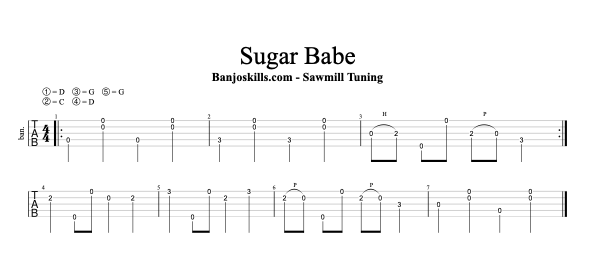
Get the Free Printable Sugar Babe Tab
Download a high-quality, printable PDF version of this tab — free. Keep it on your music stand or take it to your next jam session.
How to Play Sugar Babe - Step by Step
Get Into Sawmill Tuning
Sugar Babe is played in sawmill tuning (gDGCD). If you’re coming from standard open G, the only change is raising your second string from B to C. Use a tuner and bring it up a half step. Strum the open strings and you’ll hear that darker, modal sound right away.
For this lesson, I tune the whole banjo down a full step to better suit my voice. You don’t have to do this for the instrumental part. Standard sawmill tuning works perfectly. But if you plan on singing along and the key feels a little high, dropping everything down a step is a common trick that doesn’t change any of the fingering.
Understand Two-Finger Thumb-Lead Style
This is not a clawhammer tune. Sugar Babe is played with two-finger thumb-lead picking, which means your thumb does the heavy lifting. The downbeat is always your thumb, and your index finger fills in by snapping the top strings on the upbeat.
Here’s the basic motion: plant your pinky and ring finger on the banjo head for stability. Pluck the fourth string with your thumb, then snap your index finger across the top two strings. That’s the core of the whole style. Everything in this arrangement is built on that simple pattern.
If you’re coming from clawhammer, this will feel very different. There’s no brush stroke, no bum-ditty. The thumb is driving the melody from the bass strings while the index finger provides the rhythmic texture on top. It’s a more stripped-down approach, and it’s a lot of fun once you get the feel for it.
Learn Part One
The first part of the song is the simplest and a great place to get comfortable with the two-finger pattern. Your thumb is mostly plucking the fourth string on the downbeat while your index finger hits the top strings. The melody sits on the third and fourth strings and it’s very straightforward.
You’ll see a hammer-on and a pull-off in this section, marked with “H” and “P” in the tab. These add a little melodic movement between the thumb-lead plucks. Don’t overthink them. Just let them happen naturally as part of the phrase. Play this section slowly until the thumb-lead pattern feels automatic, then gradually bring the tempo up.
Learn Part Two (The High Part)
Part two is where the melody climbs up. Instead of sitting on the fourth string, the melody moves to the second string and the notes get higher. The thumb still plays strings two through five while the index finger plays the first string.
This part has a different feel from part one because of that higher register. It sounds great and creates a natural contrast with the lower sections. Take it measure by measure and pay attention to where the melody notes land. The rhythm stays the same. It’s still thumb on the downbeat, index finger on the upbeat.
Once you’ve got both parts solid individually, start connecting them. Play part one into part two and back to the top. That’s the whole tune. It just repeats.
Keep It Loose and Raw
This is maybe the most important part of the lesson. When you listen to Doc Boggs play this song, what makes it sound so good is that it’s not clean. It’s dirty, it’s raw, it has energy and grit. That’s the whole point.
Don’t worry about being precise. Don’t stress if the strings buzz a little or if your timing isn’t perfectly metronomic. Two-finger banjo has a rough, driving quality that comes from playing with conviction rather than perfection. Hit the strings with confidence, let the rhythm push forward, and embrace the imperfections. That’s what makes this style sound alive.
Add the Singing
Sugar Babe is really meant to be a singing song. The banjo part supports the vocals, and the two-finger style is perfect for that because it stays out of the way while still providing a strong rhythmic foundation.
Once the instrumental part is comfortable, try singing over it. The melody is simple and the lyrics are traditional, so there’s plenty of room to make them your own. If you need to slow down the banjo part to keep up with the singing, that’s completely fine. The two will sync up naturally with practice.
Practice Tips
- 1
Plant your pinky and ring fingers on the banjo head for stability. This anchoring gives your thumb and index finger a solid base to work from, and it makes the whole style feel more controlled and relaxed.
- 2
Practice the thumb-lead pattern on its own before adding the melody. Just pluck the fourth string with your thumb on the downbeat and snap the top strings with your index finger on the upbeat. Get that feel locked in before you worry about which notes to fret.
- 3
Don't try to play it clean. Doc Boggs' version has a raw, gritty energy. Let the strings buzz a little, let the timing be loose. The character of this tune comes from embracing the rough edges, not polishing them away.
Frequently Asked Questions
What style is Sugar Babe played in?
This arrangement is played in two-finger thumb-lead style, not clawhammer. Your thumb handles the melody on the downbeat while your index finger snaps the top strings. It's a simpler picking approach than three-finger or clawhammer and produces a driving, rhythmic sound.
What tuning is Sugar Babe played in?
Sugar Babe is played in sawmill tuning (gDGCD). From standard open G, you just raise your second string from B to C. You can also tune the whole banjo down a full step if you want to better suit your singing voice.
Is Sugar Babe hard to play on banjo?
It's an intermediate tune, but the two-finger style itself is very approachable. If you've never tried two-finger picking before, this is a great first song. The thumb-lead pattern is straightforward, and the embellishments (hammer-ons and pull-offs) are used sparingly.
Who is Doc Boggs?
Doc Boggs was a banjo player and singer from Virginia who recorded in the late 1920s. He's known for his raw, intense two-finger picking style and his repertoire of traditional songs and blues. His version of Sugar Babe (Red Rocking Chair) is the inspiration for this arrangement.
Can I play Sugar Babe in clawhammer style?
You could adapt it, but this particular arrangement is written for two-finger thumb-lead style. The tab and lesson are built around that picking approach. If you want to try it clawhammer, you'd need to rework the arrangement to fit the bum-ditty rhythm pattern.