How to Play Down in the Willow Garden on Banjo - Clawhammer Tab & Lesson
About This Song
Down in the Willow Garden, also known as Rose Connolly, is an Appalachian murder ballad with a story as dark as they come. The narrator takes his sweetheart on a date down to the willow garden, where he poisons her, stabs her, and throws her body in the river. It's grim subject matter delivered through a melody so beautiful it almost makes you forget what you're hearing.
The song has been recorded by many artists across different styles. My personal favorite is the Dave Evans version. Evans was a fantastic bluegrass player, and his rendition of this song is absolutely beautiful. If you're looking for a recording to study alongside this lesson, that's the one to seek out.
This arrangement is in 3/4 time, making it a waltz. That changes the fundamental picking pattern from the standard bum-ditty to bum-ditty-ditty, giving the song a rolling, swaying feel. This is the simpler version of the arrangement. A more advanced version is covered in a separate lesson.
Willow Garden Clawhammer Banjo Tab
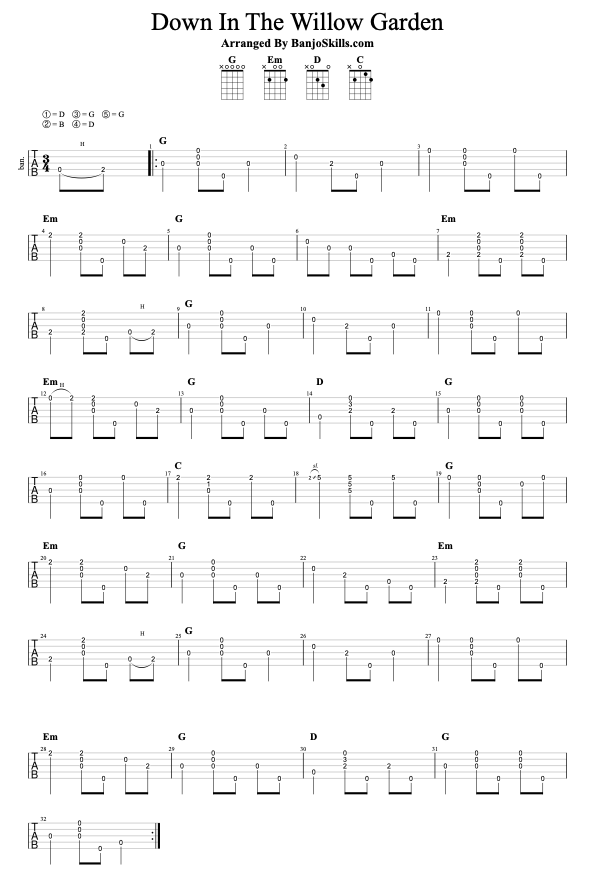
Get the Free Printable Willow Garden Tab
Download a high-quality, printable PDF version of this tab — free. Keep it on your music stand or take it to your next jam session.
How to Play Down in the Willow Garden - Step by Step
Get Comfortable With 3/4 Time
This is the single most important thing to get right before you start learning the notes. Down in the Willow Garden is a waltz, which means three beats per measure instead of four. Your standard bum-ditty pattern becomes bum-ditty-ditty.
Count it out: 1-and-2-and-3-and. Beat one is your melody note (the “bum”), and beats two and three are your ditty strokes. Practice this on open strings until it feels natural. If you’re coming from 4/4 tunes, your hand will want to add that extra beat. Resist it. Count out loud. Let the three-beat cycle become automatic before you add anything else.
Learn the Four Chords
The arrangement uses four chords: G, D, C, and E minor. G, D, and C should be familiar territory. E minor is a nice easy shape. It’s just your C chord with your index finger lifted off the second string. That small change gives you a completely different sound.
Later in the arrangement (around measure 18), there’s a C chord played up the neck as a bar chord at the 5th fret. Barring at the 5th fret can feel like a stretch, but in this arrangement you’re coming off a grace note slide, so it actually works better to fret the individual notes rather than laying a full bar across the strings. Try both approaches and see which feels more natural to you.
Work Through the First Half
Watch for the hammer-ons marked with an “H” in the tab. These are your main embellishment throughout the tune and they give the melody its character. Make sure each one rings out clearly. A weak hammer-on will disappear into the rhythm, and you want these notes to speak.
Around measure 6, you’ll hit a drop thumb passage going into the E minor chord. This is one of the trickiest spots in the whole arrangement. Slow way down here. Turn this transition into a little practice loop. Play just the measure before it and the E minor measure, back and forth, until the drop thumb feels smooth.
Work Through the Second Half
Measures 17 through 32 follow a similar structure to the first half, but with some new wrinkles. The biggest one lands in measure 18, where you’ll see a grace note slide marked “sl” in the tab. This is not a full, drawn-out slide. It happens right on the beat. You’re sliding into the target note so quickly that the starting note is barely audible. Think of it as a little flick into the note rather than a deliberate slide from point A to point B.
This same measure brings in the C chord up the neck at the 5th fret. The combination of the grace note slide and the fret-hand position shift takes some practice to nail. Work on the slide first in isolation, then add the chord shape, then connect it to the surrounding measures.
Dial In Your Dynamics
Here’s where this arrangement really comes alive. The key to the whole thing is dynamics. You want to emphasize the rhythm, specifically beat one of each measure, and let everything else sit back. That strong-weak-weak pulse is the heartbeat of the waltz, and when you lean into it, the song starts to breathe.
Don’t play every note at the same volume. Let your bum (beat one) ring out with authority, and keep your ditty-ditty strokes lighter and more relaxed. This contrast is what turns a flat run-through of the notes into something that actually sounds like music. Listen to the Dave Evans recording and pay attention to how the rhythm pushes and pulls. That feel is what you’re after.
Put It All Together
The arrangement has a repeat sign at the end, so it loops back to the beginning for each verse. Once you’ve got both halves learned, play through all 32 measures in a loop. Start slow. Use a metronome set to a waltz feel if that helps.
As you get comfortable, gradually bring the tempo up. But don’t rush it. Down in the Willow Garden is a beautiful, haunting song, and it sounds best when you give the notes room to breathe. The melody does the heavy lifting here. Your job is to deliver it with the right feel, the right dynamics, and a steady waltz pulse underneath it all.
Practice Tips
- 1
Spend time just strumming the 3/4 waltz rhythm on open strings before adding the melody. Count 1-and-2-and-3-and (bum-ditty-ditty) out loud until it feels second nature. Most clawhammer players are wired for 4/4, and switching to three beats per measure takes deliberate practice.
- 2
Isolate the drop thumb run going into the E minor chord around measure 6. Loop just that transition slowly with a metronome. This is one of the trickiest spots in the arrangement, and getting it smooth will make a big difference in how the whole tune flows.
- 3
Focus on dynamics above everything else. This is a song where the feel matters more than nailing every note perfectly. Emphasize beat one of each measure and let the other notes sit back. That strong-weak-weak waltz pulse is what gives the song its mood.
Frequently Asked Questions
What time signature is Down in the Willow Garden in?
Down in the Willow Garden is in 3/4 time, which makes it a waltz. Instead of the standard four-beat bum-ditty pattern, you play a three-beat bum-ditty-ditty pattern. Count it as 1-and-2-and-3-and. Each measure has three beats instead of four, and that rolling rhythm is a big part of what gives the song its character.
What chords does Down in the Willow Garden use?
The arrangement uses four chords: G, D, C, and E minor. E minor is essentially the same shape as C, but you lift your index finger off the second string. There's also a C chord played up the neck as a bar chord at the 5th fret, though you can fret the notes individually instead of barring.
How hard is Down in the Willow Garden to play on banjo?
It's an intermediate tune. The 3/4 time signature is the biggest adjustment if you're used to playing in 4/4. The chord shapes are all common, and the techniques (hammer-ons, drop thumb, a grace note slide) are standard clawhammer vocabulary. If you can play a basic bum-ditty, you're ready for this one.
What is a grace note slide?
A grace note slide (marked 'sl' in the tab) happens right on the beat, not before it. You slide into the target note so quickly that the starting note barely registers. It's a subtle ornament that adds expression without taking up extra rhythmic space. You'll see it in measure 18 of this arrangement.
Is this the same as Rose Connolly?
Yes. Down in the Willow Garden and Rose Connolly are two names for the same traditional Appalachian murder ballad. You'll see it listed under both titles depending on the source. The song, the story, and the melody are the same regardless of which name is used.