How to Play Angeline the Baker on Banjo - Clawhammer Tab & Lesson
About This Song
Angeline the Baker is one of those tunes you'll hear at just about every old-time jam. It's catchy, it's fun, and it's a fantastic reason to try out Double C tuning if you've only played in open G so far. The tuning gives the song a bright, ringing quality that you just can't get in standard tuning.
You only need two chords for this one: D and G. The melody is simple, the structure is two parts with repeats, and the whole thing sits nicely under your fingers once you get the tuning sorted out. If you've been wanting to explore Double C, this is the song to start with.
Angeline the Baker Clawhammer Banjo Tab
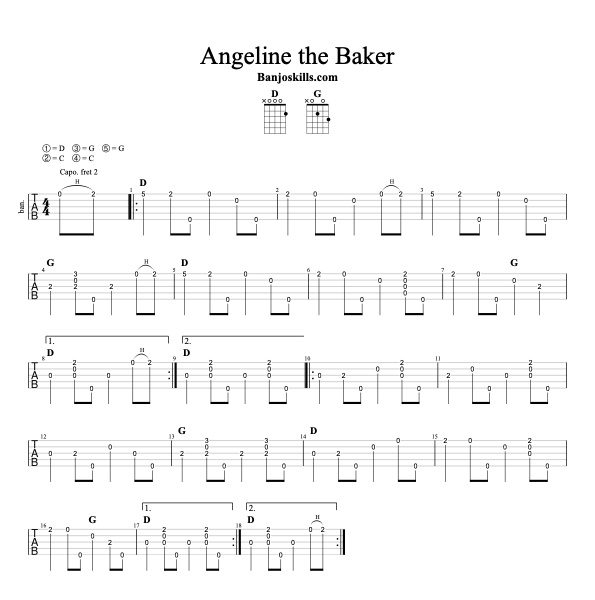
Get the Free Printable Angeline the Baker Tab
Download a high-quality, printable PDF version of this tab — free. Keep it on your music stand or take it to your next jam session.
How to Play Angeline the Baker - Step by Step
Get Into Double C Tuning
Before anything else, you need to retune your banjo. Angeline the Baker is played in Double C tuning (gCGCD). Starting from standard open G tuning (gDGBD), here’s what changes:
- 4th string: D goes down to C
- 2nd string: B goes up to C
Once you’re in Double C, throw a capo on the second fret. This brings everything up so you’re in the key of D, which is the standard key for this tune. Use a tuner to make sure everything is solid before you start playing.
Learn the Two Chords
The great news is you only need two chords for this entire song: D and G. In Double C tuning with the capo on the second fret, these shapes are comfortable and easy to grab. Check the chord diagrams at the top of the tab to see exactly where your fingers go.
Practice switching back and forth between D and G until it feels natural. This is the foundation for everything else.
Work Through the A Part
The A part is the main melody of the tune. It starts on the D chord and has a bright, bouncy feel. You’ll notice hammer-ons marked in the tab. These are spots where you place a finger down onto a string to sound a note, rather than picking it. They give the melody a smooth, connected sound.
The A part has first and second endings. That means you play through the section, take the first ending, repeat back to the beginning, play through again, and then take the second ending to move on. It sounds more complicated than it is. Just follow the repeat signs in the tab.
Work Through the B Part
The B part has a different feel. The melody sits in a slightly different spot, and you’ll see more hammer-ons here too, along with some single-note strikes that give this section its own character.
Just like the A part, the B part has first and second endings with repeat signs. Play through, take the first ending, go back, play through again, and take the second ending to finish.
Put It All Together
The full tune goes: A part (with repeats), then B part (with repeats). At a jam session, you’d play through this whole cycle multiple times. Start slow, maybe around 80 beats per minute, and gradually bring the speed up as you get comfortable.
Make It Your Own
Once you can play through both parts cleanly, start listening for spots where you can add your own flavor. Maybe you emphasize a brush stroke a little more, or you let a note ring out a bit longer. The melody is the anchor, and as long as you keep that intact, you’ve got room to experiment. Angeline the Baker is one of those tunes that sounds great at any speed and any skill level, so enjoy the process of making it yours.
Practice Tips
- 1
Get comfortable switching between your D and G chords in Double C tuning before trying to play through the melody. These two shapes are the only ones you need, so make them second nature.
- 2
Pay attention to the hammer-ons in the tab. They give the tune its character, but if they feel tricky at first, just play the fretted note without the hammer-on and add it back in later.
- 3
Practice each part (A and B) separately until you can play them cleanly, then connect them. The repeat signs and first/second endings can be confusing at first, so take it slow.
Frequently Asked Questions
What tuning is Angeline the Baker played in?
Angeline the Baker is played in Double C tuning (gCGCD). You'll also want a capo on the second fret, which brings the pitch up to the key of D. Double C is one of the most common alternate tunings for clawhammer banjo.
Is Angeline the Baker hard to play on banjo?
Not at all. It's a great beginner tune, especially if you're looking to try out Double C tuning for the first time. You only need two chords (D and G), and the melody is straightforward and repetitive. The hardest part is probably getting comfortable with the new tuning.
What chords are used in Angeline the Baker?
Just two chords: D and G. In Double C tuning, the D chord shape and G chord shape are both simple and comfortable. The chord diagrams are shown at the top of the tab.
Do I need a capo for Angeline the Baker?
Yes. This arrangement uses a capo on the second fret. The capo brings the tuning up so the song sounds in the key of D, which is the standard key for this tune at jam sessions.
What is Double C tuning?
Double C tuning is gCGCD. Compared to standard open G (gDGBD), you lower your fourth string from D to C and raise your second string from B to C. Your first string stays at D. It gives your banjo a bright, open sound and is used for many classic old-time tunes.