How to Play Bury Me Beneath the Willow on Banjo - Clawhammer Tab & Lesson
About This Song
Bury Me Beneath the Willow is a classic folk ballad about a broken-hearted lover. The Carter Family recorded one of the most well-known versions back in 1927, and it's been a standard in country and folk music ever since. It's one of those songs that just sounds right on the banjo.
This is one of the best songs for a beginning clawhammer player to learn. It uses just three chords (G, C, and D), has a beautiful melody that sits naturally on the banjo, and the structure is straightforward. The arrangement is 16 measures long with a repeat, so you loop through it for each verse. Simple, beautiful, and satisfying to play.
Bury Me Beneath the Willow Clawhammer Banjo Tab
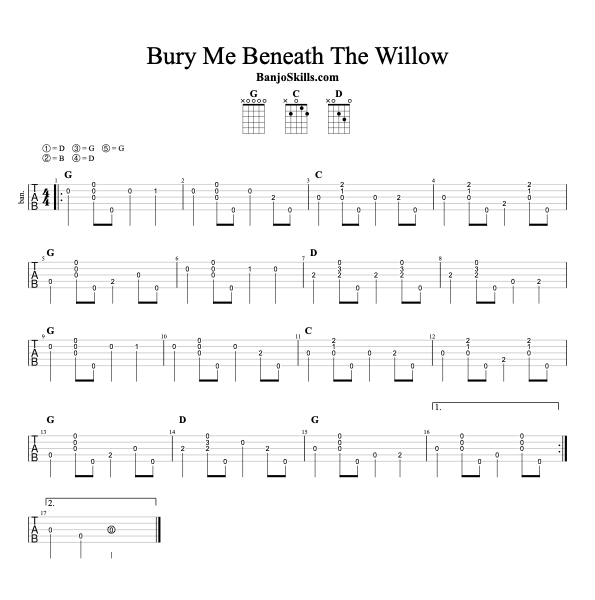
Get the Free Printable Bury Me Beneath the Willow Tab
Download a high-quality, printable PDF version of this tab — free. Keep it on your music stand or take it to your next jam session.
How to Play Bury Me Beneath the Willow - Step by Step
Get the Three Chords Down
This song uses three chords: G, C, and D. If you’ve been playing clawhammer for even a short while, you probably already know these shapes. The chord diagrams are printed at the top of the tab for quick reference.
Learn the A Part
The A part covers the first eight measures. Notice how the melody has a gentle, rolling quality. That’s the song’s character. Don’t rush it. Let each note ring out before moving to the next. This is a ballad, and it should feel relaxed and unhurried.
Work through the A part slowly, measure by measure. Once you can play through all eight measures without stopping, start bringing it up to speed gradually.
Learn the B Part
The B part covers measures 9 through 16. The melody is similar to the A part but resolves differently at the end, with the D chord building a little tension before landing back on G. The transition from D to G in measures 14-15 is the trickiest spot in the tune. The chord change happens while the melody is still moving. Slow this section down and loop it until the change feels natural.
Add the Hammer-Ons
Throughout the tab, you’ll see several notes marked with an H for hammer-on. These are the spots where you strike a string open and then hammer a fretting finger down onto a fret to sound a second note. Hammer-ons give the melody its singing quality and are one of the most important embellishments in clawhammer banjo.
Make sure each hammer-on rings clearly. The hammered note should be just as loud as the picked note. If it’s weak or buzzy, you need more finger force and accuracy. Practice each hammer-on in isolation before putting it back into the full measure.
Put It All Together
The arrangement is 16 measures long with first and second endings. The first time through, you take the first ending and loop back to the beginning. The second time, you skip to the second ending, which wraps things up.
Once you’ve got all the sections learned individually, play through the entire arrangement slowly from start to finish. Use a metronome if that helps you stay steady. Gradually bring the tempo up, but remember this is a ballad. It sounds best at a moderate, relaxed pace. The beauty of this song is in the melody, so give every note space to breathe.
Make It Your Own
Once you’re comfortable with the arrangement as written, start paying attention to dynamics. Let the melody notes ring out a bit louder than the rhythm strokes. Lean into the notes that carry the vocal line and soften the in-between strokes. This is how you turn a correct run-through of the notes into something that actually moves people. Bury Me Beneath the Willow is a heartfelt song, and the more feeling you put into your playing, the better it sounds.
Practice Tips
- 1
Learn the A part first and get it solid before moving on to the B part. Once both halves feel comfortable on their own, start connecting them.
- 2
Pay close attention to the hammer-ons marked in the tab. They add the vocal-like quality to the melody and make the difference between a flat run-through and something that actually sounds like the song.
- 3
Practice the transition from D back to G in measures 14-15 until it's smooth. This is where most beginners stumble because the chord change comes right in the middle of a melodic phrase.
Frequently Asked Questions
What tuning is Bury Me Beneath the Willow played in?
This arrangement is in standard Open G tuning (gDGBD). No retuning needed if your banjo is already in standard tuning. The key of G works beautifully for this song and keeps the chord shapes simple.
Is Bury Me Beneath the Willow hard to play on banjo?
It's a great beginner tune. You only need three chords (G, C, and D), and the melody moves at a comfortable pace. The hammer-ons are the main technique to work on, but they're straightforward. If you can play a basic bum-ditty and know your G, C, and D chord shapes, you're ready for this one.
What chords does Bury Me Beneath the Willow use?
The arrangement uses three chords: G, C, and D. The chord diagrams are included at the top of the tab. G is your home base, C shows up in the middle of each section, and D appears near the end before resolving back to G.
Who originally recorded Bury Me Beneath the Willow?
The song is a traditional folk ballad with unknown authorship. It first appeared in a 1909 folk song collection. The Carter Family recorded one of the most well-known early versions in 1927, and it has been covered by dozens of artists since then, including Dolly Parton and Molly Tuttle.
What techniques are used in this arrangement?
The main embellishment in this arrangement is the hammer-on, marked with an H in the tab. These add melodic interest and help the banjo imitate the vocal melody. Beyond that, it's standard clawhammer picking with the bum-ditty pattern.