How to Play Cluck Old Hen on Banjo - Clawhammer Tab & Lesson
About This Song
Cluck Old Hen is a traditional fiddle and banjo tune that has been played in the Appalachian region for generations. The exact origins are murky, as is the case with most old-time tunes, but it has been a staple of the tradition for well over a century. The song has a distinctive, slightly off-kilter feel that comes from the sawmill tuning and the unusual chord shapes.
What makes Cluck Old Hen so great is its versatility. It can be played simply as a bare-bones arrangement that sounds beautiful and a little creepy, or it can be dressed up with embellishments to make it really pop. It might just be the perfect banjo song. It's also a great song to sing with, and the melody lends itself well to both vocal and instrumental versions.
Cluck Old Hen Clawhammer Banjo Tab
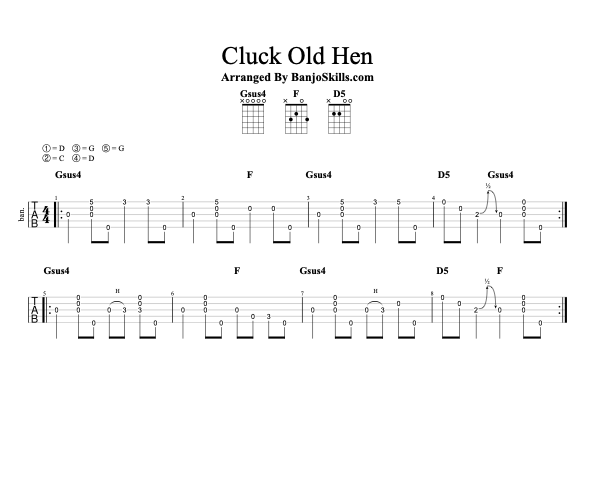
Get the Free Printable Cluck Old Hen Tab
Download a high-quality, printable PDF version of this tab — free. Keep it on your music stand or take it to your next jam session.
How to Play Cluck Old Hen - Step by Step
Get Into Sawmill Tuning
Just like Shady Grove, Cluck Old Hen lives in sawmill tuning (gDGCD). If you’re already in sawmill, you’re good to go. If not, tune your second string up from B to C. Everything else stays the same as standard open G.
Give the open strings a strum and let your ears settle into that dark, modal sound. This is home base for the tune.
Learn the Chords
Here’s where Cluck Old Hen gets interesting. The chords for this tune are unlike what you’ll find in most beginner songs:
- Gsus4 - this is your home chord, and it has a suspended, unresolved quality
- F - adds warmth and movement away from the home chord
- D5 - a spare, open-sounding chord that creates tension
These shapes might feel unfamiliar at first, and that’s fine. They’re a big part of what gives Cluck Old Hen its slightly off-kilter vibe. Practice switching between them until the changes feel smooth.
The A part chord progression goes: Gsus4 - F - Gsus4 - D5 - Gsus4
The B part is similar: Gsus4 - F - Gsus4 - D5 - F
Notice the only difference is how each part resolves at the end.
Learn the A Part
The A part is the verse, and in its simplest form it’s beautifully spare. Play through the melody slowly and focus on clean notes and smooth chord changes. Even at its most basic, the A part has a haunting quality that sounds great.
Don’t rush to add embellishments here. The bare-bones version of the A part is genuinely beautiful on its own. Let it breathe.
Learn the B Part
The B part is the chorus and has its own character. Same approach: learn the melody slowly, get the chord changes smooth, and play it through until it feels natural.
Once you’ve got both parts down, put them together. The song follows the standard AABB structure, so play the A part twice, then the B part twice, and repeat.
Add Hammer-Ons and String Bends
Now for the fun part. The tab includes hammer-ons that add drive and connect melody notes with a punchy, ascending sound. You’ll also see string bends, which are where you push a string sideways to bend the pitch up slightly. String bends give the tune a bluesy, expressive quality that sounds fantastic.
For the string bends, take your time. Practice bending the string on its own first to get a feel for how much pressure to apply and what the bent note should sound like. You want a controlled, deliberate bend, not a wild yank. Once you can get a consistent sound, work it back into the arrangement.
Layer these embellishments in one at a time. Pick one hammer-on or one bend, practice that measure on a loop, and then move on to the next.
Make It Your Own
Cluck Old Hen is one of those tunes that sounds great at every level. The bare-bones version is haunting and lovely. The embellished version is driving and full of personality. And everything in between works too.
Feel free to mix and match. Maybe you play the A part simply and save the embellishments for the B part. Maybe you add a string bend in one spot that isn’t in the tab because it sounds good to you. The melody and those unusual chords are doing most of the heavy lifting. Everything else is just seasoning. Make it yours.
Practice Tips
- 1
Spend some time getting comfortable with the chord shapes first, especially Gsus4, F, and D5. These aren't your typical open G chords, and they give the tune its distinctive character. Make sure you can switch between them cleanly before tackling the melody.
- 2
Keep the A part simple at first. The bare-bones version sounds beautiful on its own, a little haunting, a little creepy in the best way. You can always dress it up later once the foundation is solid.
- 3
When you start working on the string bends, isolate them. Practice the bend on its own until you can control how far you push the string and get a consistent sound. Then plug it back into the arrangement.
Frequently Asked Questions
What tuning is Cluck Old Hen played in?
Cluck Old Hen is played in sawmill tuning (gDGCD). That's the same as standard open G except the second string goes up from B to C. This gives the tune its dark, modal sound.
What chords does Cluck Old Hen use?
The main chords are Gsus4, F, and D5. These are unusual shapes that you won't see in standard open G songs, and they're a big part of what gives Cluck Old Hen its distinctive, off-kilter character.
Is Cluck Old Hen hard to play?
The basic version is very accessible for beginners. The melody is simple and the structure is clear. The embellished version adds hammer-ons and string bends, which bring it more into intermediate territory, but you can work up to those gradually.
What gives Cluck Old Hen that off-kilter sound?
It's a combination of the sawmill tuning and the unusual chord shapes. Gsus4, F, and D5 aren't the chords you hear in most beginner banjo songs, and they create a slightly unsettled, modal sound that's really distinctive. It's part of what makes the tune so memorable.
What's the best way to embellish Cluck Old Hen?
Start with the bare-bones arrangement and then add hammer-ons and string bends one at a time. The hammer-ons add drive and connect the melody notes smoothly. The string bends give you that bluesy, expressive quality. Layer them in gradually rather than trying to play the full embellished version right away.