How to Play Cluck Old Hen on Banjo - Two-Finger Thumb Lead Tab & Lesson
About This Song
Cluck Old Hen is a haunting little Appalachian tune. One of the earliest transcriptions dates back to 1886, and Fiddlin' John Carson recorded it in 1923. It's usually played in a modal key, which is exactly why it sounds a bit tense and a bit mysterious. This version is two-finger thumb lead banjo: two right hand fingers, two left hand frets, eight measures, and it sounds great.
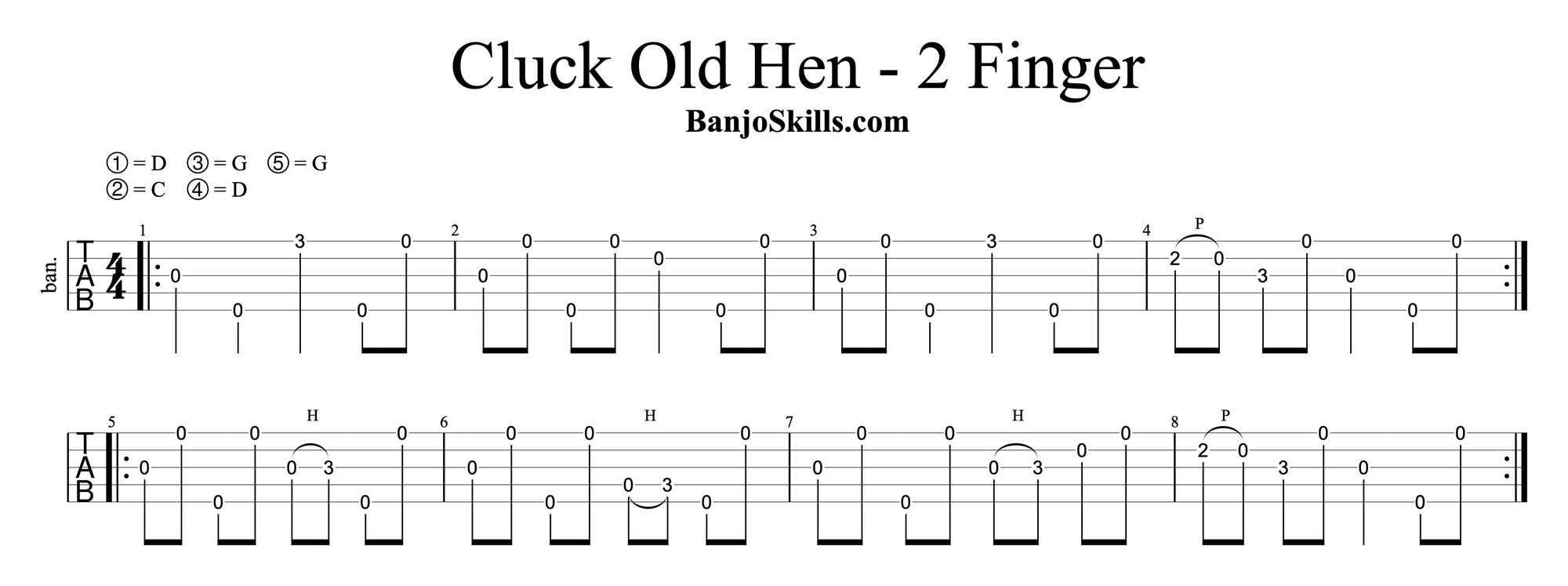
Cluck Old Hen Two-Finger Banjo Tab
Get the Free Printable Cluck Old Hen Tab
Download a high-quality, printable PDF version of this tab — free. Keep it on your music stand or take it to your next jam session.
How to Play Cluck Old Hen - Step by Step
Get Into Sawmill Tuning
Start in standard open G tuning (gDGBD). Then raise your 2nd string a half step, from B up to C. You should end up at gDGCD.
That one change knocks the banjo out of a plain major key and into something modal. It’s halfway between major and minor, and it’s what gives this tune its haunting Appalachian sound.
Learn the Two-Finger Motion
This is the whole style in one sentence: your thumb plays strings 5, 4, 3, and 2, and your index finger only ever plucks the 1st string. You always lead with the thumb, which is why it’s called thumb lead.
A lot of players plant their ring finger and pinky on the head for stability. If that’s uncomfortable, skip it.
Try this before you touch the tune. Thumb on the 3rd string, index on the 1st string, thumb on the 5th string, index on the 1st string. Count 1 2 3 4. Go slow and make the notes even. The goal is no big volume jumps between notes and no fingernail catching the string. That’s it. That’s the motion you’ll use for every measure.
Learn the A Part
The A part is measures 1 through 4, and it repeats. Your left hand only ever plays the 2nd and 3rd frets, so keep your index finger anchored around the 2nd fret and use your middle finger for the 3rd.
Measure 1: thumb on the open 3rd string, thumb on the 5th, then your index plays the 3rd fret of the 1st string. Finish with a 5th string, 1st string pair. Count it 1, 2, 3, 4 and.
Measure 2 doesn’t use your left hand at all. Open 3rd string, then 5th and 1st, then the open 2nd string with your thumb, then 5th and 1st again.
Measure 3 is the same as measure 1.
Measure 4 has the pull-off, which is the trickiest spot in the tune. Put your index finger on the 2nd fret of the 2nd string, pluck it with your thumb, and pull your finger off so the open string sounds on the “and”. Then play the 3rd fret of the 3rd string, the open 3rd string, and finish with 5th and 1st.
Play the A part through twice before moving on.
Learn the B Part
The B part is measures 5 through 8, and it also repeats. It’s easier than the A part.
Measures 5, 6, and 7 all start the same way: open 3rd string, then 5th and 1st. Then comes a hammer-on. In measure 5 you pluck the open 3rd string and hammer a finger down onto the 3rd fret on the “and” of the beat. Measure 6 does the same move on the 4th string. Measure 7 is back on the 3rd string, and after the hammer-on you play the open 2nd string and then the 1st.
Measure 8 is exactly the same as measure 4, pull-off and all.
Work on the Hammer-Ons and Pull-Offs
There are three hammer-ons (measures 5, 6, and 7) and two pull-offs (measures 4 and 8). All of them land on the “and” of a beat, so count “1 and 2 and 3 and 4 and” out loud and aim to have the hammered or pulled note arrive right on the “and”.
Don’t think about them too hard. Get them roughly in time and roughly even in volume and move on. Like every embellishment, they’re optional. If they’re tripping you up, play the notes straight for now and add them back in once the rest of the tune is steady.
Make It Your Own
People sometimes dismiss two-finger style because it’s simple. That’s a shame, because simple is the point. This version of Cluck Old Hen is eight measures long and it sounds beautiful. Once it’s under your fingers, try it with the intermediate tab, or take the same two-finger motion to another tune. Sugar Babe (also called Red Rocking Chair) is a great next one.
Practice Tips
- 1
Get the basic two-finger motion even before you touch the tune. Thumb on the 3rd string, index on the 1st, thumb on the 5th, index on the 1st. Count 1 2 3 4 out loud and aim for the same volume on every note.
- 2
Keep your index finger parked near the 2nd fret and your middle finger over the 3rd. Those are the only two frets in the whole tab, so there's no reason for your left hand to wander.
- 3
Learn measures 1 and 2, then loop them. Measure 3 is identical to measure 1 and measure 8 is identical to measure 4, so once those two feel good you already know most of the tune.
- 4
Don't overthink the hammer-ons and pull-offs. Play them straight first, then add them in once the rest of the measure is steady. There's always time to clean them up later.
Frequently Asked Questions
What is two-finger thumb lead banjo?
It's an older banjo style where your thumb plays the 5th, 4th, 3rd, and 2nd strings and your index finger only ever plucks the 1st string. You always lead with the thumb, which is where the name comes from. It's about the simplest right hand motion there is on the banjo.
What tuning is this version of Cluck Old Hen in?
Sawmill tuning, gDGCD. From standard open G (gDGBD), you raise the 2nd string a half step from B up to C. That one change takes you out of a regular major key and into a modal sound, which is what gives the tune its haunting Appalachian feel.
Is two-finger Cluck Old Hen good for beginners?
Yes, it's one of the easiest full tunes you can learn. The whole arrangement is eight measures, the left hand only uses the 2nd and 3rd frets, and the right hand motion takes about a minute to learn. The only embellishments are three hammer-ons and two pull-offs, and you can leave those out until you're ready.
Can I play this if I normally play clawhammer?
Absolutely. The tune and the tuning are the same as the clawhammer version on this site. The only thing that changes is the right hand. If you keep a longer index fingernail for clawhammer, watch that it doesn't catch the 1st string when you pluck it.
Is there a more advanced version?
Yes. Once this one feels comfortable, there's an intermediate tab linked from the video. It's the same tune with a bit more going on, and it's a natural next step.