How to Play Gospel Plow on Banjo - Clawhammer Tab & Lesson
About This Song
Gospel Plow (also known as Keep Your Hand on the Plow) is a powerful traditional spiritual with a message of perseverance and faith. You might know it from Bob Dylan's debut album, or from Mahalia Jackson's gospel version. It's one of those songs that crosses every genre boundary and sounds great on the banjo.
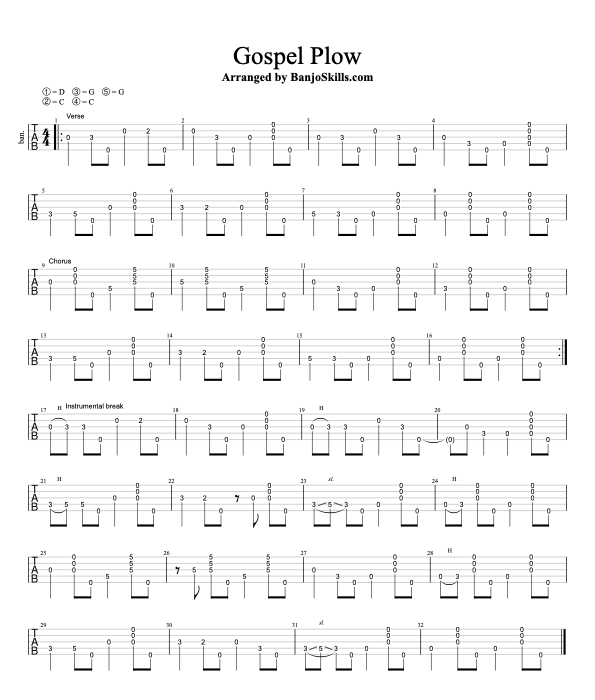
This arrangement is in Double C tuning and includes three distinct sections: a verse, a chorus, and an instrumental break. The verse and chorus are straightforward enough for beginners, while the instrumental break adds some embellishments that give you something to work toward. It's a great tune for developing your ability to play through a song with multiple sections.
Gospel Plow Clawhammer Banjo Tab
Get the Free Printable Gospel Plow Tab
Download a high-quality, printable PDF version of this tab — free. Keep it on your music stand or take it to your next jam session.
How to Play Gospel Plow - Step by Step
Get Into Double C Tuning
Gospel Plow is played in Double C tuning (gCGCD). From standard Open G (gDGBD), you need to change two strings:
- Lower your 4th string from D down to C
- Raise your 2nd string from B up to C
Your 1st string stays at D, 3rd at G, and 5th at G.
Strum the open strings once you’re tuned up and listen to the sound. Double C has a bright, open character that works perfectly for this song. You’ll hear that open C string droning underneath everything you play, and that drone is a big part of the arrangement’s sound.
Learn the Verse
The arrangement is clearly divided into three sections, and the tab labels them for you: Verse, Chorus, and Instrumental Break. Start with the verse (measures 1-8).
The verse follows the vocal melody closely. As always with clawhammer, we use a basic bum-ditty pattern. Take it measure by measure and focus on getting each note clean and clear. There’s nothing tricky here technically. Just solid, clean clawhammer playing. Get this section feeling comfortable before moving on.
Learn the Chorus
The chorus (measures 9-16) shifts the melody to reflect the “Hold On” refrain. The playing pattern stays consistent with the verse, but you’ll notice the melody sits in a slightly different position on the neck. Same tempo, same feel, different melodic phrase.
Pay attention to how the chorus resolves back to the open strings at the end. That resolution gives you a clear landing point before the instrumental break begins. Practice the last measure of the chorus going into the first measure of the break until that transition is seamless.
Tackle the Instrumental Break
The instrumental break (measures 17-32) is where the arrangement really opens up. This is a banjo solo section, and it adds embellishments to the melody that the verse and chorus keep simple.
You’ll encounter hammer-ons (marked H in the tab) throughout this section. These add rhythmic punch and melodic interest. Each hammer-on should ring out clearly. Bring your fretting finger down with authority so the hammered note rings just as strongly as a struck note.
Slides (marked sl) also appear in the instrumental break. These connect phrases smoothly, giving the melody a vocal quality. Practice each slide passage on its own. Start on the correct fret, apply firm pressure, and glide to the target fret in one smooth motion. The target note is what your listener hears, so make sure it lands cleanly.
Connect All Three Sections
Once you’ve got each section learned individually, it’s time to play through the full arrangement: verse, chorus, instrumental break. The break combines the verse and chorus melodies and dresses them up with hammer-ons and slides, so once you’ve got the first two sections under your fingers, the break will feel familiar.
Focus on the transitions between sections. These are the spots where most players lose their flow. The last measure of each section should lead naturally into the first measure of the next. If a transition feels choppy, isolate those two measures and loop them until they connect smoothly.
Make It Your Own
Gospel Plow is a song with deep roots and a powerful message. Once the notes are solid, think about the feel you want to convey. Keep the tempo steady throughout, and let the dynamics do the work. The instrumental break is your chance to really dig in and play with confidence.
Don’t be afraid to let certain notes ring out longer or to soften other passages. The song has a built-in dynamic range, and your playing should reflect that. A flat, even volume throughout will sound correct but lifeless. Let the music breathe, and this arrangement will reward you with a tune that feels genuinely good to play.
Practice Tips
- 1
Learn the verse and chorus first. The instrumental break combines those two melodies and adds embellishments on top, so getting the verse and chorus solid first makes the break much easier to pick up.
- 2
Pay close attention to the slide passages in the instrumental break. These connect phrases in a way that makes the melody sing. Practice each slide slowly, making sure you land cleanly on the target fret.
- 3
Keep your tempo steady from start to finish. The break adds embellishments, but it's not faster than the verse and chorus. Lock in a comfortable speed and hold it all the way through.
Frequently Asked Questions
What tuning is Gospel Plow played in?
This arrangement is in Double C tuning (gCGCD). From standard Open G, lower your 4th string from D to C and raise your 2nd string from B up to C. Everything else stays the same. The key of C suits the song well and the open strings provide a natural drone underneath the melody.
Is Gospel Plow hard to play on banjo?
The verse and chorus sections are beginner-friendly with straightforward playing patterns. The instrumental break is a step up, with hammer-ons and slides that require more coordination. Overall, it's a great tune for a player who has the basics down and is ready for something with a bit more structure.
What is the structure of this arrangement?
The arrangement has three sections: a verse (measures 1-8), a chorus (measures 9-16), and an instrumental break (measures 17-32). The verse and chorus follow the vocal melody closely, while the instrumental break is a more elaborate banjo arrangement with added embellishments.
Is Gospel Plow the same as Keep Your Hand on the Plow?
Yes. Gospel Plow, Keep Your Hand on the Plow, and Hold On are all names for the same traditional spiritual. The song goes by different titles depending on the performer and the tradition. Bob Dylan recorded it as Gospel Plow on his 1962 debut album, which is one of the most widely known versions.
What techniques are used in this arrangement?
The arrangement uses hammer-ons (marked H) and slides (marked sl) as its primary embellishments. These appear mainly in the instrumental break section. The verse and chorus sections are mostly straightforward clawhammer playing, making them accessible for beginners while the break provides a technical challenge.