How to Play Hills of Mexico on Banjo - Clawhammer Tab & Lesson
About This Song
Hills of Mexico is a traditional American folk ballad that has traveled through many hands and gone by many names. The song belongs to a family of related ballads that traces back to an 1850s Canadian lumberjack song called "Canaday-I-O." Over the decades, the story was adapted by cowboys and buffalo hunters on the southern plains, and it appeared under titles like "The Buffalo Skinners" and "On the Trail of the Buffalo." John Lomax collected an early version of "The Buffalo Skinners" for his 1910 book Cowboy Songs, and Other Frontier Ballads.
The version most banjo players know today owes a lot to Roscoe Holcomb, whose raw, powerful singing style defined the song for a generation of old-time musicians. Willie Watson (of Old Crow Medicine Show) recorded a well-known version called "Mexican Cowboy" on his 2014 album Folk Singer Vol. 1, bringing the song to a wider audience. Many great musicians have put their own stamp on it over the last century.
The song tells the story of a young cowboy lured into a hard journey with promises of good pay, only to face rough conditions and broken promises. It is a working person's song, full of grit and longing. On the banjo, it translates beautifully into an upbeat clawhammer arrangement in open G.
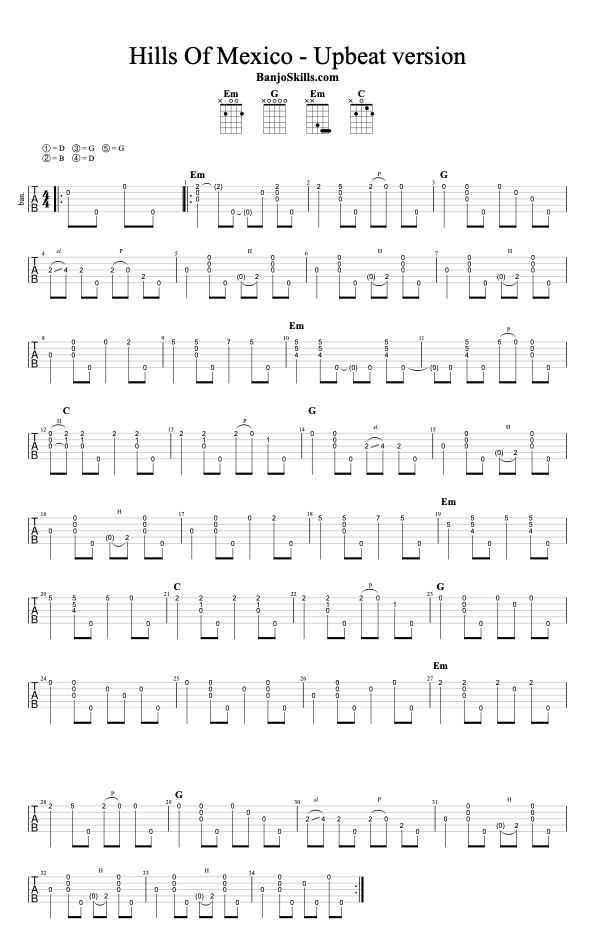
Hills of Mexico Clawhammer Banjo Tab
Get the Free Printable Hills of Mexico Tab
Download a high-quality, printable PDF version of this tab — free. Keep it on your music stand or take it to your next jam session.
How to Play Hills of Mexico - Step by Step
Get Into Tune
We’re in standard open G tuning (gDGBD) for this one. No capo, no retuning. Just make sure your banjo is in tune and you’re good to go. This arrangement is labeled “Upbeat version” in the tab, so it has a lively, driving feel to it.
Get the Chord Progression Down
The chord progression for Hills of Mexico uses three chords: Em, G, and C. Here’s how it lays out:
- Line 1: | Em | Em | G | G |
- Line 2: | G | G | G | G |
- Line 3: | G | Em | Em | C |
- Line 4: | C | G | G | G |
- Line 5: | G | G | Em | Em |
- Line 6: | C | C | G | G |
- Line 7: | G | G | Em | Em |
- Line 8: | G | G | G | G |
- Line 9: | G | G |
It’s a longer progression than a lot of tunes, but the changes are predictable once you feel the shape of the song. G is home base, with Em and C adding tension and movement. Before diving into the tab, strum through the progression and get comfortable with where the changes fall.
Learn the First Half
Start with the first page of the tab. Play through it slowly, measure by measure. The melody is very singable, which means it should feel natural under your fingers once you hear it in your head.
You’ll notice the melody weaves between fretted notes and open strings. That’s a big part of what gives the tune its character in open G tuning. Focus on getting the notes clean and the rhythm steady before worrying about any of the embellishments.
Learn the Second Half
The second half of the tab continues the melody and brings it home. Same approach: take it slow, work measure by measure, and connect the phrases. Once you can play both halves separately, start linking them together. The repeat sign at the end means you loop the whole thing.
Add the Ornaments
This is where the arrangement really starts to shine. You’ll see three types of embellishments marked in the tab: hammer-ons (H), pull-offs (P), and slides (sl).
Hammer-ons give you that punchy, ascending sound. Pull-offs create a smooth, descending connection between notes. Slides add a vocal-like quality, gliding from one note to the next.
Don’t try to add all of them at once. Pick one measure where an embellishment appears, loop that measure until it feels smooth, then move on to the next. Layer them in one at a time. Once they’re all in place, the tune will have a lot more life and energy.
Make It Your Own
Hills of Mexico is a song with a long history and a lot of personality. Once you’ve got the arrangement under your fingers, start thinking about how you want to play it. Maybe you lean into certain embellishments more than others, or you find spots where you want to let the melody breathe a little longer.
This is also a great tune to sing along with. The banjo part works beautifully as accompaniment, so if you know the lyrics, try singing over your playing. That combination of voice and clawhammer banjo is exactly how this song has been passed down for over a century.
Practice Tips
- 1
Break the song into small sections and loop each one until it feels comfortable. This arrangement is longer than a lot of tunes, so working in chunks keeps things manageable.
- 2
When you hit the hammer-ons, pull-offs, and slides, isolate those measures and drill them separately. Get the embellishment sounding clean on its own before plugging it back into the full melody.
- 3
Play along with the slow version in the video. Match your timing to it, follow the tab, and gradually build up speed over days and weeks. There's no rush.
Frequently Asked Questions
What tuning is Hills of Mexico played in?
Hills of Mexico is played in standard open G tuning (gDGBD). No capo needed. Just tune up and you're ready to go.
What key is Hills of Mexico in?
This arrangement is in the key of G. The chord progression uses G, Em, and C. It's a longer progression than a lot of tunes, but the changes are predictable once you feel the shape of the song.
Is Hills of Mexico hard to play on banjo?
It's an intermediate tune. If you're comfortable with basic songs like Cripple Creek and Boil Them Cabbage Down, you're ready to give this one a shot. The hammer-ons, pull-offs, and slides add some challenge, but the melody is very singable and logical.
What techniques does this arrangement use?
This version uses hammer-ons, pull-offs, and slides to add movement and expression to the melody. These embellishments give the tune its character and keep the rhythm driving forward.
Where can I hear a good version of Hills of Mexico?
Willie Watson's recording of "Mexican Cowboy" on his album Folk Singer Vol. 1 is a great place to start. Roscoe Holcomb's version is another classic. Both will give you a feel for the melody and spirit of the song before you sit down with the tab.