How to Play I'll Fly Away on Banjo - Clawhammer Tab & Lesson
About This Song
I'll Fly Away is one of the most recorded gospel songs of all time. It was written by Albert E. Brumley in 1929 and first published in 1932. Brumley reportedly said he was inspired while picking cotton as a young man, and the song reflects that longing to escape to something better. It has since been recorded by hundreds of artists across gospel, country, bluegrass, and folk traditions.
On the banjo, I'll Fly Away works beautifully in Double C tuning. The melody sits right on the chord tones, which means you can hold a chord shape and find most of the melody notes without doing much with your left hand. This makes it a great song for beginners who are just getting into Double C, and it can grow with you as you add more embellishments over time.
I'll Fly Away Clawhammer Banjo Tab
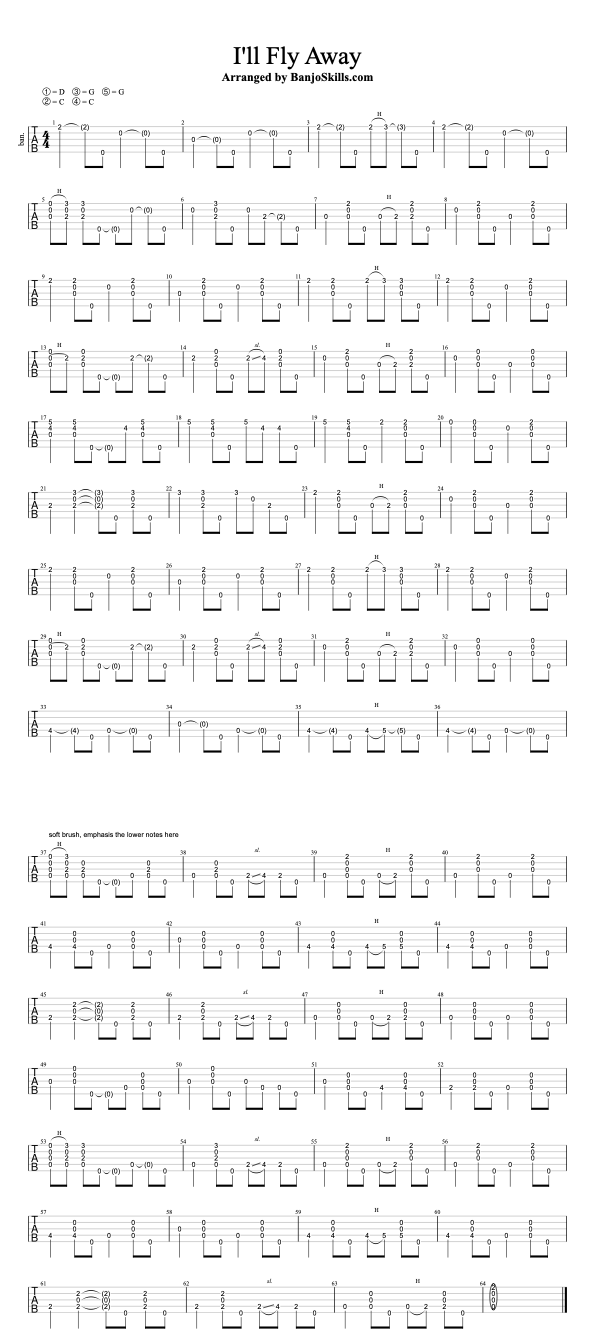
Get the Free Printable I'll Fly Away Tab
Download a high-quality, printable PDF version of this tab — free. Keep it on your music stand or take it to your next jam session.
How to Play I’ll Fly Away - Step by Step
Get Into Double C Tuning
Before we do anything else, let’s get into Double C tuning. Starting from standard open G (gDGBD), you need to retune two strings: drop your fourth string from D down to C, and raise your second string from B up to C. That gives you gCGCD.
Strum the open strings and let yourself get used to the sound. It’s a warmer, more mellow tone than open G, and it’s perfect for this song.
Learn the Chords
We’re using three chords for this one: C, F, and G. That’s your 1-4-5 in the key of C, the same relationship as G, C, and D in open G, just moved to a different key.
The C chord is your home base, and you’ll spend most of your time there. Practice switching between all three until the transitions feel smooth. Pay attention to the F chord especially, since it might be less familiar than the other two.
Learn the A Part
The A part carries the main melody of the song. What’s really nice about this arrangement is that the melody notes sit right on the chord tones. That means if you hold down your chord shape, most of the melody notes are already under your fingers.
Work through the A part slowly, measure by measure. Follow the tab and let the melody guide you. You’ll notice how naturally the notes fall. That’s Double C tuning doing its thing.
Learn the B Part
The B part is mostly the same as the A part, with one key difference: the first couple of measures go up the neck around the 4th and 5th fret area. This gives the B part a slightly different character and adds some variety to the tune.
Take those opening measures of the B part on their own and get comfortable with the position shift before connecting them to the rest. Once you’re past those first couple of measures, you’re back in familiar territory.
Add Hammer-Ons
Once you have both parts sounding solid, start working in the hammer-ons. Look for the spots marked with an “H” in the tab. These add a smooth, connected feel to the melody and give the tune a little extra lift.
You’ll also see some slides and skips in the tab. The slides add a vocal quality to certain phrases, and the skips create a lighter feel by leaving space in the rhythm. Add these in gradually. There’s no rush.
Make It Your Own
This is a song with a lot of heart, and it sounds beautiful even at its most basic. Once you’re comfortable with the full arrangement, try playing around with the dynamics. Let some phrases ring out louder and pull others back. That push and pull is what makes a performance feel alive. The melody is your anchor, and everything else is just you putting your own stamp on it.
Practice Tips
- 1
If Double C tuning is new to you, spend some time just strumming the open strings and getting familiar with how it sounds before diving into the tab. It's a different world from open G, and your ear needs a minute to adjust.
- 2
Practice holding your chord shapes while playing the melody notes. In this arrangement, most of the melody sits right on the chord tones, so keeping that chord shape down gives your fingers a head start.
- 3
Let hammer-ons flow naturally rather than forcing them in. If a hammer-on feels awkward in a particular spot, skip it for now and play the note cleanly. You can always add it back in later once the rest of the arrangement is solid.
Frequently Asked Questions
What tuning is I'll Fly Away played in?
This arrangement is in Double C tuning (gCGCD). You'll need to retune your fourth string down from D to C and your second string up from B to C. It's a common alternate tuning for clawhammer banjo and opens up a whole new set of songs.
What are the chords for I'll Fly Away?
Three chords: C, F, and G. That's the 1-4-5 progression in the key of C. If you're used to playing G, C, and D in open G tuning, this is the same relationship, just in a different key.
Is I'll Fly Away beginner friendly?
Yes. The melody is simple and sits nicely on the chord tones, so you don't have to do a lot of stretching or jumping around with your left hand. The main challenge for true beginners might be getting comfortable with Double C tuning if you've only played in open G before.
What makes this arrangement unique?
This arrangement takes advantage of Double C tuning to let the melody ring out naturally over the chord shapes. The B part goes up the neck around the 4th and 5th fret area, which gives it a different character from the A part. There are also some skips and slides that add texture without making it overly complicated.
Can I play I'll Fly Away in open G tuning instead?
You could work out an open G arrangement, but it wouldn't sound quite the same. Double C tuning gives this song a particular warmth and lets the melody fall in very natural places on the fretboard. It's worth learning the tuning. You'll use it for plenty of other songs too.