How to Play In the Pines on Banjo - Clawhammer Tab & Lesson
About This Song
In the Pines is one of the oldest and most widely recorded folk songs in American music. The earliest known versions date back to the 1870s in the southern Appalachians, and the song has been collected by folklorists under many names including "Where Did You Sleep Last Night", "Black Girl", and "The Longest Train". Lead Belly recorded a definitive version in the 1940s, and Nirvana famously covered it on their 1994 MTV Unplugged album, introducing the song to a whole new generation.
The song has a dark, haunting quality that makes it unlike most other beginner banjo songs. It's in 3/4 time, which gives it a waltz-like feel, and the sparse arrangement really lets the vocals shine. On the banjo, we keep things simple and moody. This is a song where less is more.
In the Pines Clawhammer Banjo Tab
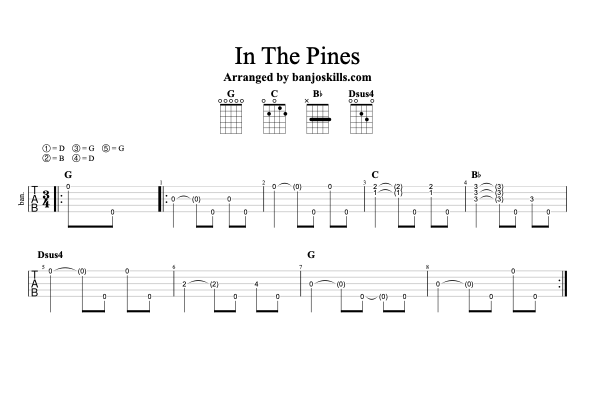
Get the Free Printable In the Pines Tab
Download a high-quality, printable PDF version of this tab — free. Keep it on your music stand or take it to your next jam session.
How to Play In the Pines - Step by Step
Get Into Tune
We’re in standard open G tuning (gDGBD) for this one. In the video, I tune down a half step to better fit my voice, but that’s completely optional. If you’re just learning the tune on the banjo, standard tuning works great. If you want to sing along and the key feels a little high, try tuning everything down a half step and see if that sits better for you.
Understand 3/4 Time
This is probably the biggest thing to wrap your head around with In the Pines. Most banjo songs are in 4/4 time, where your bum-ditty pattern goes: 1 2-and 3 4-and. But In the Pines is in 3/4 time, a waltz, so we only have three beats per measure instead of four.
The modified rhythm pattern is: 1 2-and 3-and. You still have that bum-ditty feel, but it’s compressed into three beats. Practice this on open strings until it feels natural. Count it out loud if you need to. Once this rhythm clicks, the rest of the song falls into place pretty easily.
Learn the Chords
We’ve got four chords to work with: G, C, Bb, and Dsus4. The progression is:
| G | C | Bb | Dsus4 | G |
G and C should feel familiar. The Bb is a bar chord. You’ll lay your index finger across the strings. If this is your first bar chord, be patient with yourself. It takes a little while for your hand to build up the strength. The Dsus4 is a nice, easy shape that resolves beautifully back to G.
Practice the chord changes slowly, just strumming the 3/4 rhythm pattern on each chord. Don’t worry about the tab yet. Just get comfortable moving through the progression.
Play Through the Tab
The tab for In the Pines is only two lines long, and that’s intentional. This is a very sparse arrangement. You’ll notice skips (the parenthesized notes in the tab). These create a lighter, more open feel by leaving space in the rhythm. They add to that haunting, understated quality.
Play through the tab slowly and pay attention to where the chord changes land within the 3/4 rhythm. Let notes ring out. Don’t rush through the spaces.
Make It Your Own
In the Pines is a song made for singing. The banjo part is really there to support the vocals, so don’t feel like you need to make the banjo arrangement busier or more complex. If anything, simpler is better here. The dark, moody atmosphere of this song comes from restraint, from what you don’t play as much as what you do. Let the melody breathe, lean into that waltz feel, and enjoy the space.
Practice Tips
- 1
Spend time just strumming the 3/4 rhythm pattern (1 2-and 3-and) on open strings before adding any chord shapes. Getting that waltz feel into your picking hand is the most important thing here.
- 2
Practice moving to the Bb bar chord slowly and cleanly. It's okay if it takes a while to sound right. Bar chords are a new muscle for most beginners. Try fretting just the bar and strumming to make sure every string rings clearly.
- 3
Resist the urge to fill every beat with notes. This arrangement is sparse on purpose. The empty space is what gives the song its haunting, moody feel.
Frequently Asked Questions
What tuning is In the Pines played in?
In the Pines is played in open G tuning (gDGBD). You can optionally tune your banjo down a half step to better fit your vocal range, but standard open G works just fine.
What time signature is In the Pines in?
In the Pines is in 3/4 time, which gives it a waltz feel. Instead of the standard bum-ditty pattern (1 2-and 3 4-and), you play a modified pattern: 1 2-and 3-and. It feels different at first, but once you get the hang of it, it's very natural.
What are the chords for In the Pines?
There are four chords: G, C, Bb, and Dsus4. The progression goes G - C - Bb - Dsus4 - G. It's a simple cycle that repeats throughout the song.
Is the Bb chord hard?
The Bb (or A#) is a bar chord, which can be challenging if you haven't played one before. You lay your index finger flat across multiple strings. It takes some hand strength and practice, but it gets easier quickly. Start by just getting the chord shape clean, then work on switching to it smoothly.
How slow should I play In the Pines?
As slow as feels comfortable. This is a moody, atmospheric song. It's not a barn burner. A slower tempo actually sounds better and gives you more room to breathe between chord changes. Let the notes ring out and sit in the spaces.