How to Play Jingle Bells on Banjo - Clawhammer Tab & Lesson
About This Song
Jingle Bells is one of the most recognizable songs in the world. It was written by James Lord Pierpont and published in 1857 under the title "One Horse Open Sleigh." The song was originally written for Thanksgiving, not Christmas, but it quickly became associated with the winter holiday season and has stayed there ever since.
This is a fun one to pull out during the holidays. It works surprisingly well on clawhammer banjo, and the melody sits nicely in open G tuning. The version we're learning here is a beginner-friendly arrangement that keeps things simple on purpose. When you're playing for friends and family, you want people singing along, not sitting there watching you show off. A clean, straightforward arrangement does exactly that.
You only need three chords for this song: G, C, and D. The structure has two main parts, a verse and a chorus, and both are easy to pick up.
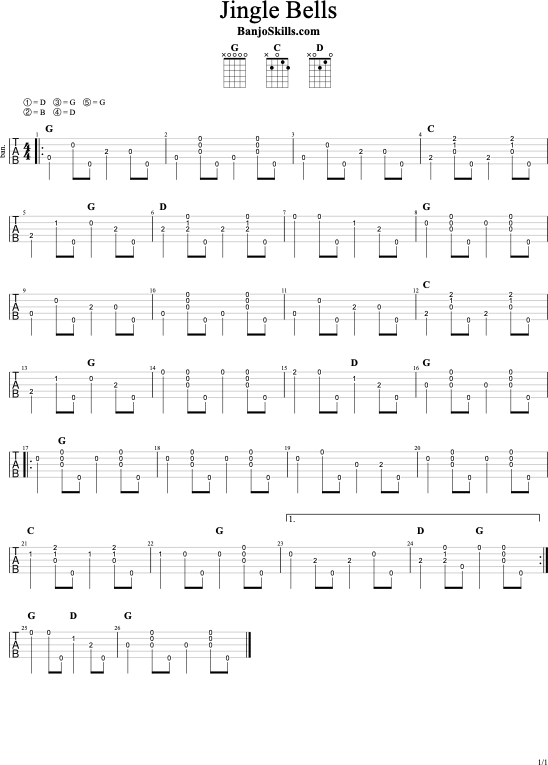
Jingle Bells Clawhammer Banjo Tab
Get the Free Printable Jingle Bells Tab
Download a high-quality, printable PDF version of this tab — free. Keep it on your music stand or take it to your next jam session.
How to Play Jingle Bells - Step by Step
Get the Chord Progression Down
We’re in standard open G tuning (gDGBD), and you only need three chords for this song: G, C, and D.
- G is your open strings. Home base.
- C is your middle finger on the second fret of the fourth string, first finger on the first fret of the second string, and ring finger on the second fret of the first string.
- D is your middle finger on the second fret of the third string and first finger on the first fret of the second string.
Practice switching between all three until the changes feel smooth. The verse and chorus both move through these chords at a comfortable pace, so you have time to make each change, but you want it to feel automatic.
Learn the Verse Melody
The verse is the “Dashing through the snow” part. Play through the melody slowly and hum along. You already know how this song goes, so use that to your advantage. If a note sounds off, your ear will catch it.
The verse melody starts on the G chord, moves through C and D, and comes back to G. It repeats with a slightly different ending the second time through. Take it one line at a time and get each phrase comfortable before stringing them together.
Learn the Chorus Melody
The chorus is the “Jingle bells, jingle bells, jingle all the way” part. This is the part everyone wants to hear, and it’s even simpler than the verse. The melody sits mostly over the G chord, with a move to C and then D before coming back to G.
Play through the chorus melody on its own a few times. Once you have both the verse and chorus melodies under your fingers, try playing the whole song straight through.
Add the Bum-Ditty Rhythm
Now it starts to sound like clawhammer banjo. Take the melodies you’ve learned and layer the bum-ditty rhythm over them. On beats where there’s a melody note, play that note. On beats where there’s no melody note, fill in with the bum-ditty pattern: brush stroke, thumb pluck.
The tab has the full arrangement written out with the bum-ditty already built in. Work through it measure by measure. The rhythm is steady and consistent throughout, which makes this a great song for locking in that fundamental clawhammer pattern.
Put It All Together
Once you can play through the verse and chorus with the bum-ditty rhythm, run the whole song from start to finish. The verse plays twice (with that slightly different ending on the second pass), and then the chorus comes in.
Don’t rush it. A slower, steady version of Jingle Bells will always sound better than a fast, sloppy one. Play along with the video to check your timing.
Play It for People
This is the whole point. Jingle Bells is a song that’s meant to be shared. When the holidays come around, grab your banjo and play it for friends and family. Keep it simple, let people sing along, and have fun with it. A straightforward arrangement that supports singing will always go over better than a flashy solo nobody can follow.
Practice Tips
- 1
Learn the verse and chorus melodies separately before trying to play the whole song. The verse ('Dashing through the snow') and chorus ('Jingle bells, jingle bells') have different feels, so get each one solid on its own first.
- 2
Keep it simple. This song sounds best played straight ahead without a lot of fancy tricks. Focus on clean melody notes and a steady bum-ditty rhythm.
- 3
Practice playing it while someone sings along. This is a song that's built for sing-alongs, and playing simply while supporting a vocalist is a valuable skill.
Frequently Asked Questions
What tuning is Jingle Bells played in?
This arrangement is in standard open G tuning (gDGBD). That's the most common tuning for clawhammer banjo, so you won't need to retune if you've been playing other beginner songs.
What are the chords for Jingle Bells on banjo?
Three chords: G, C, and D. These are the same three chords you'll find in most beginner banjo songs, so if you already know Cripple Creek or Boil Them Cabbage Down, you're all set.
Is Jingle Bells hard to play on clawhammer banjo?
Not at all. This is a beginner-friendly arrangement with no fancy techniques. If you can play a basic bum-ditty rhythm and switch between G, C, and D, you can play this song.
Can I play Jingle Bells as a sing-along?
Absolutely, and that's exactly how it sounds best. When you keep the arrangement simple, it supports the vocals and makes it easy for everyone to sing along. This is the perfect song to play for friends and family during the holidays.
What's the structure of Jingle Bells?
The song has two main parts: a verse ('Dashing through the snow') and a chorus ('Jingle bells, jingle bells'). The verse repeats with a slightly different ending the second time, and then the chorus comes in. Both parts use the same three chords.