How to Play Lazy John on Banjo - Clawhammer Tab & Lesson
About This Song
Lazy John is a mellow, laid-back old-time tune from the Cumberland Plateau region of Kentucky and Tennessee. The lyrics describe someone lounging in the shade while the narrator works in the hot sun, and the way I play it, the tune sounds about as relaxed as the guy in the song.
For banjo players, Lazy John is a great intermediate tune. It uses three chords (G, C, and D), but the real work is in the right hand: there's a ton of syncopation and lots of lush brush strokes. It's a satisfying one to get under your fingers and it sounds great at a jam.
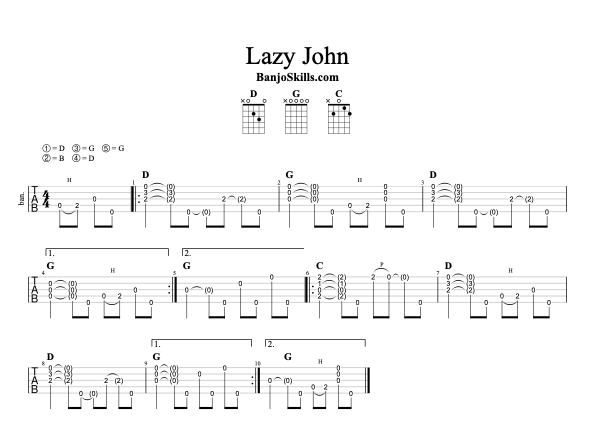
Lazy John Clawhammer Banjo Tab
Get the Free Printable Lazy John Tab
Download a high-quality, printable PDF version of this tab — free. Keep it on your music stand or take it to your next jam session.
How to Play Lazy John - Step by Step
Get the Chord Progression Down
We’re in standard open G tuning (gDGBD), and this tune uses three chords: G, C, and D. The song has two parts, each with 1st and 2nd endings. Get the chord changes comfortable first so you can put your attention on the rhythm.
Learn the A Part
Take the A part slowly and get the notes clean before you worry about anything else.
There are 1st and 2nd endings for the A part. The first time through, you take the 1st ending and loop back to the beginning. The second time, you take the 2nd ending and move on to the B part. Practice both endings so the transition feels natural.
Learn the B Part
Just like the A part, the B part has 1st and 2nd endings. The 2nd ending wraps things up and brings you back to the top of the tune. Practice the B part on its own until it feels solid, then start connecting it to the A part.
Add the Hammer-Ons and the Pull-Off
You’ll see hammer-ons marked with an “H” throughout the tab. They typically happen on the lower strings, where you strike an open string and then hammer down onto the 2nd fret. There’s also a single pull-off (marked “P”) in the B part. Pull-offs are the opposite move: strike a fretted note and pull your finger off to sound the open string.
The key with both is to make them crisp and rhythmic. You want the hammered or pulled note to ring out just as clearly as the struck note. Practice each spot in isolation before trying to play through the whole tune with them. Like all embellishments, they’re optional, so feel free to play the notes straight until the tune feels comfortable.
M-skips and Syncopation
This is the heart of the arrangement. Throughout the tab you’ll see notes in parentheses. These are M-skips. The easiest way to think about them is that you’re “skipping” the brush stroke. Your clawhammer motion remains the same, but instead of going for the “dit” of your bum-ditty, you’re just going to move your fingers past the strings.
On top of the M-skips, there’s a lot of syncopation in general. Don’t try to analyze it all at once. Take it slow, one measure at a time, and count out loud while you play: “1 and 2 and 3 and 4 and.” Counting out loud is the fastest way to understand what’s actually happening with the rhythm. Once you can feel where the notes land at a slow tempo, speeding up is the easy part.
Put It All Together
Once both parts are comfortable on their own, start playing the full AABB structure. The form goes: A part (with repeat), then B part (with repeat), then back to the top. Keep your tempo steady and relaxed, and let those brush strokes ring out.
Make It Your Own
Lazy John rewards a relaxed, in-the-pocket approach. The more laid back your rhythm feels, the better it sounds. Once the arrangement feels natural, you can start experimenting with the dynamics. Try leaning into the brush strokes a little more, or easing off in spots to let the syncopation breathe. The melody is the backbone, and as long as that’s solid, you’ve got room to play.
Practice Tips
- 1
Pay close attention to the 1st and 2nd endings in both the A part and B part. Practice the transition into each ending separately so you don't stumble when the repeat comes around.
- 2
Count out loud while you play, especially through the syncopated spots. Saying "1 and 2 and 3 and 4 and" as you go makes it much easier to feel where the notes land.
- 3
Start slow and stay slow longer than you think you need to. This tune is laid back anyway, so there's no rush. Let the brush strokes ring and let the syncopation settle in before you bring the tempo up.
Frequently Asked Questions
What tuning is Lazy John played in?
Lazy John is played in standard open G tuning (gDGBD). No capo needed for this one. The tune sits comfortably in the key of G.
Is Lazy John hard to play on banjo?
It's an intermediate tune. The chords are simple, but the arrangement uses a lot of syncopation and M-skips, plus 1st and 2nd endings in both parts. If you're comfortable with beginner songs like Cripple Creek and Boil Them Cabbage Down and you're ready to work on your rhythm, this is a good next step.
What are the chords for Lazy John?
Three chords: G, C, and D. It's a straightforward progression, so you can put most of your attention on the right hand.
Where does Lazy John come from?
The tune comes from the Cumberland Plateau area of Kentucky and eastern Tennessee. Its popularity in old-time music traces back to fiddler Clyde Davenport, who learned it from a radio broadcast, possibly from a western swing recording by Johnny Lee Wills in the 1940s.