How to Play Old Joe Clark on Banjo - Clawhammer Tab & Lesson
About This Song
Old Joe Clark is a classic Appalachian fiddle tune that has been played at dances and jam sessions for well over a century. The song is believed to be named after a real person, Joseph Clark, who lived in Clay County, Kentucky around the time of the Civil War. There are dozens of verses, many of them humorous or nonsensical, that have been added over the years.
The tune was first recorded in the 1920s and has since been played by countless musicians in old-time and bluegrass traditions. It's one of those tunes you'll hear at just about every jam session, and it's a great one to have in your back pocket. It's an absolute classic and loads of fun to play.
Old Joe Clark uses the A mixolydian scale, which is why it has that bright, slightly different sound compared to most songs in standard G. You don't need to know any theory to play it, but it's worth knowing that's where the distinctive flavor comes from. The version we're learning here is an intermediate arrangement that sounds impressive but is totally within reach.
Old Joe Clark Clawhammer Banjo Tab
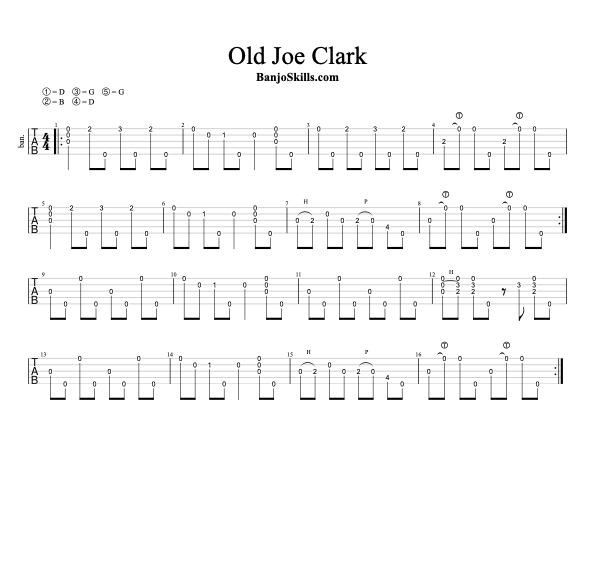
Get the Free Printable Old Joe Clark Tab
Download a high-quality, printable PDF version of this tab — free. Keep it on your music stand or take it to your next jam session.
How to Play Old Joe Clark - Step by Step
Set Up Your Capo
Since Old Joe Clark is in the key of A and we’re in open G tuning, you’ll need to capo at the 2nd fret and tune your 5th string up to an A. This puts you in the key of A while keeping all your familiar open G chord shapes. Everything you play will sound two frets higher than usual.
Get the Chord Progression Down
The chord progression for Old Joe Clark is nice and straightforward. The song mostly sits on A, with E7 adding tension and G appearing briefly in the B part:
- A part: | A A | A A | A A | E7 E7 | A A | A A | A E7 | A A |
- B part: | A A | A A | A A | G G | A A | A A | A E7 | A A |
Get comfortable with the chord changes for both parts before diving into the melody. The chord progression is the roadmap, and knowing where you’re going makes everything easier.
Learn the A Part
The A part is where the main melody lives. Play through it slowly and focus on getting the notes clean. There’s a lot of character in this melody, and it’s worth taking the time to really learn it well.
Try humming or singing the A part to yourself. Once the melody is in your ear, your fingers will follow much more easily. The A part repeats, so you play it twice before moving to the B part.
Learn the B Part
The B part has a different feel from the A part, and it gives the tune its full shape. Same approach here: play it slowly, get the notes right, and commit the melody to memory before worrying about anything else.
Once you’ve got both parts under your fingers separately, start putting them together. Play AABB and loop it. That’s the whole song structure.
Add Hammer-Ons and Pull-Offs
This is where the arrangement really comes alive. You’ll see hammer-ons and pull-offs marked in the tab, and they add a lot of drive and energy to the tune. Hammer-ons give you that punchy, ascending sound, while pull-offs create a smooth, descending connection between notes.
Don’t try to add all of them at once. Pick one spot where a hammer-on or pull-off appears in the tab, practice that measure on its own until it feels natural, then move on to the next one. Layer them in gradually.
Make It Your Own
Old Joe Clark is one of those songs that every player puts their own spin on. Once you’re comfortable with the arrangement as written, feel free to experiment. Maybe you add an embellishment in a spot that isn’t in the tab, or maybe you simplify a measure that feels too busy. The melody is the anchor. As long as that’s solid, everything else is just flavor.
This is a tune you’ll play for years, and it’ll keep evolving as your playing does. That’s what makes it such a great one to know.
Practice Tips
- 1
Learn the A part and B part separately before trying to play them back to back. Each part has its own feel, and you'll make faster progress by focusing on one at a time.
- 2
When working on the hammer-ons and pull-offs, isolate just the measure where they happen. Loop that measure over and over until the embellishment feels smooth, then plug it back into the full arrangement.
- 3
When you're capoed up at the 2nd fret, the spacing between frets will feel slightly different from playing open position. Take it slow and let your fingers adjust to the new geography. It'll feel natural before long.
Frequently Asked Questions
What tuning is Old Joe Clark played in?
Old Joe Clark is played in open G tuning (gDGBD) with a capo at the 2nd fret and the 5th string tuned up to A. This puts you in the key of A while keeping all your familiar open G chord shapes.
Is Old Joe Clark hard to play on banjo?
It's an intermediate tune. If you're comfortable with basic songs like Cripple Creek and Boil Them Cabbage Down, you're ready to tackle Old Joe Clark. The hammer-ons and pull-offs add some challenge, but the melody itself is very logical.
What's the difference between the A part and B part?
The A part is the verse and tends to have more melodic movement. The B part is the chorus and has a different feel. Both parts repeat, so the full song goes AABB over and over. Learning them separately makes the whole thing much more manageable.
Why is Old Joe Clark in the key of A if we're in open G tuning?
You capo at the 2nd fret and tune your 5th string up to A. That raises everything two frets, putting you in the key of A while keeping all your familiar open G chord shapes. The tune uses the A mixolydian scale, which is why it has that bright, slightly different sound compared to most songs in standard G.
What embellishments does this version of Old Joe Clark use?
This arrangement uses hammer-ons and pull-offs to add flavor and drive. These are the main embellishments you'll see in the tab. They give the tune more energy and help connect the melody notes in a way that feels natural on the banjo.