How to Play Old Molly Hare on Banjo - Clawhammer Tab & Lesson
About This Song
Old Molly Hare is a traditional American folk song that has been passed down through generations of old-time musicians. It's one of those playful, upbeat animal songs that were common in the Appalachian tradition, the kind of tune that puts a smile on your face. The lyrics are simple and fun, often sung as a call-and-response.
On the banjo, Old Molly Hare is a great introduction to playing just a little bit up the neck. We don't go past the seventh fret, so it's not scary, but it gives you a taste of what's possible beyond the first few frets. The song is in Double C tuning and has a bright, energetic feel that makes it a joy to play.
Old Molly Hare Clawhammer Banjo Tab
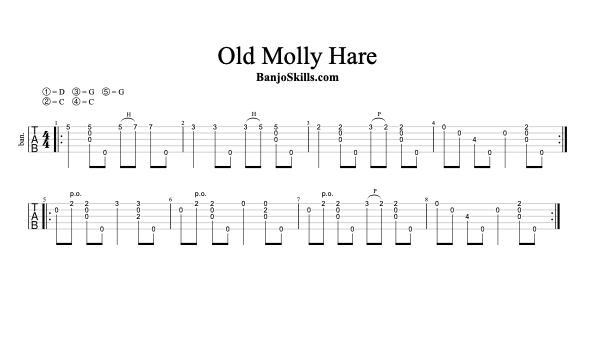
Get the Free Printable Old Molly Hare Tab
Download a high-quality, printable PDF version of this tab — free. Keep it on your music stand or take it to your next jam session.
How to Play Old Molly Hare - Step by Step
Get Into Double C Tuning
Old Molly Hare is played in Double C tuning (gCGCD). If you’re coming from standard open G, your fourth string goes from D down to C, and your second string goes from B up to C. Strum the open strings and make sure everything sounds right before you start.
Learn the A Part
The A part is where we get to go up the neck a little bit. Don’t let that intimidate you, we’re not going far, just up to around the 5th fret. The melody starts up there and then slides down through positions: 5th fret, then 3rd fret, then 2nd fret. Think of it as a smooth descent down the neck.
The key here is keeping your hand relaxed as you move between positions. You don’t want to grip the neck tightly. Just let your hand glide. Play through it slowly at first and focus on making each slide clean and connected. Once the position shifts feel natural, bring it up to speed.
Learn the B Part
The B part stays in a more familiar position closer to the nut. This is where you’ll find the pull-offs, fretted notes pulling off to open strings. Use your ring finger for these, and really commit to the pull. A half-hearted pull-off sounds mushy. You want that open string to ring out clearly.
You’ll also see some fretted alternate string pull-offs in here. These are pull-offs where you’re pulling off on one string while the melody continues on another. It sounds more complicated than it is. Just take it measure by measure.
Add Embellishments
Once you’ve got both parts down, you can start layering in some extra flavor. Hammer-ons give the tune a percussive pop. Drop thumb adds rhythmic drive and fills out the sound. These are tools in your toolbox. You don’t have to use all of them all the time.
Try adding one embellishment at a time. Get comfortable with hammer-ons in a couple of spots, then try adding some drop thumb. Layer them in gradually rather than trying to do everything at once.
Make It Your Own
The tab represents one particular way to play Old Molly Hare, one snapshot of the song on one particular day. Old-time music is a living thing, and the beauty of it is that you can make every tune your own. Simplify it when you want to relax, add embellishments when you want to show off, and don’t be afraid to experiment. As long as the melody is there, you’re playing Old Molly Hare.
Practice Tips
- 1
Work on the slides between positions in the A part (5th fret to 3rd fret to 2nd fret) until they feel smooth and connected. The key is keeping your hand relaxed as you shift down the neck.
- 2
For the pull-offs in the B part, use your ring finger to fret the note and pull off cleanly. Make sure the open string rings out clearly after the pull. A weak pull-off will swallow the note.
- 3
Once you can play both parts, try mixing up the fancy and simple versions. Play it stripped down for a verse, then add the embellishments for the next one. That kind of variety keeps the tune interesting.
Frequently Asked Questions
What tuning is Old Molly Hare played in?
Old Molly Hare is played in Double C tuning (gCGCD). To get into Double C from standard open G, you tune your second string up from B to C and your fourth string down from D to C. It's a very common old-time tuning.
Is Old Molly Hare hard to play?
It's a beginner-friendly tune, but it does have a few moments that stretch you a bit. The A part takes you up the neck to around the fifth fret, and the B part has some pull-offs. Nothing too intimidating, though. It's a great next step once you've got a couple of songs under your belt.
What's the hardest part of Old Molly Hare?
The slides between positions in the A part, moving from the 5th fret down to the 3rd and then the 2nd, can feel awkward at first. Your hand needs to shift smoothly without losing the rhythm. Start slow and let the muscle memory build up.
Do I need to go up the neck for this song?
Yes, but just a little. You'll go up to around the 5th to 7th fret area in the A part, which is very manageable. Think of it as a gentle introduction to playing beyond the first few frets. It's a good confidence builder.
How do I make Old Molly Hare sound less repetitive?
The trick is to vary your arrangement each time through. Play it simple one time, then add in hammer-ons and pull-offs the next. Use drop thumb in some measures but not others. The tab represents one way to play it, but feel free to simplify or embellish as you go. That's how old-time musicians keep a tune fresh.