How to Play Will the Circle Be Unbroken on Banjo - Clawhammer Tab & Lesson
About This Song
Will the Circle Be Unbroken is one of the most recognizable hymns in American music. The original version, titled "Will the Circle Be Unbroken?", was written by Ada R. Habershon with music by Charles H. Gabriel and published in 1907. The song became a cornerstone of country and folk music after the Carter Family recorded their iconic version in 1935, which is the arrangement most people know today.
It's a song that brings people together. You'll hear it at jam sessions, church gatherings, and front porches all across the country. For banjo players, it's an ideal early song because it uses just three chords (G, C, and D) and spends most of its time on the open G chord, meaning your left hand gets a break for much of the song.
Will the Circle Be Unbroken Clawhammer Banjo Tab
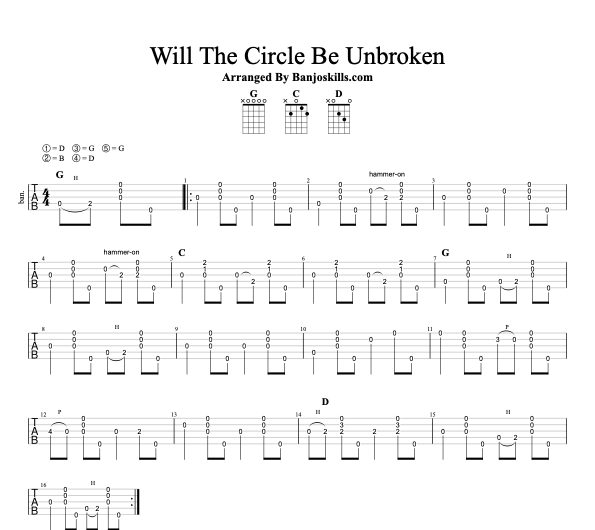
Get the Free Printable Will the Circle Be Unbroken Tab
Download a high-quality, printable PDF version of this tab — free. Keep it on your music stand or take it to your next jam session.
How to Play Will the Circle Be Unbroken - Step by Step
Get the Chord Progression Down
We’re in standard open G tuning (gDGBD), and this song uses just three chords: G, C, and D. The great news is that you’ll be spending most of your time on the G chord, so there’s not a lot of frantic switching going on.
The song starts with a pickup measure on G, and then the progression moves through G, C, and D in a way that feels very natural. Practice moving between these three chords until the transitions are smooth. Pay special attention to that G-to-C change. It comes up the most and you want it to feel effortless.
Learn the Melody
If you’ve ever hummed this song, you already know the melody. That’s the beauty of learning tunes that everybody recognizes. Your ear already knows where the notes should go.
Play through the melody slowly, one measure at a time. The tab has five lines, and the melody follows the vocal line pretty closely. Notice how much of the melody falls on open strings or notes you’re already fretting as part of your chord shapes. That’s what makes this song so beginner-friendly.
Add the Bum-Ditty Rhythm
Once you have the melody under your fingers, layer in the bum-ditty rhythm. Your basic pattern is melody note, brush, thumb. That steady 1-2-and feel that drives clawhammer banjo forward.
On beats where there’s no melody note, you fill in with a brush stroke and thumb pluck. On beats where there is a melody note, play that note and follow it with a thumb pluck. This gives you a full, complete-sounding arrangement even before you add any embellishments.
Embellish with Hammer-Ons
Hammer-ons are the main embellishment for this song, and they’re a great technique to get comfortable with. The idea is simple: anytime you’re going from an open string to a fretted note, instead of picking that fretted note, you can hammer your fretting finger down onto it.
Look through the tab for spots marked with an “H”. Those are your hammer-on opportunities. Start by adding just one or two that feel natural, and gradually work in more as you get comfortable. They give the melody a smoother, more connected sound and add a little bit of momentum to the tune.
Make It Your Own
Once you’re comfortable with the basic arrangement and some hammer-ons, experiment. Try playing it a little slower for a more reverent feel, or pick up the tempo for a lively jam session version. The melody is the anchor. As long as that’s solid, you can’t really go wrong. This is one of those songs you’ll come back to again and again, and it’ll sound a little different every time.
Practice Tips
- 1
Spend extra time on your chord transitions, especially G to C. The song hangs on the G chord for most of its length, so when the C does come around, you want that switch to be smooth and confident.
- 2
Start with the basic melody and bum-ditty rhythm before adding any hammer-ons. Get the bare bones version sounding solid first, then layer in the embellishments one at a time.
- 3
Play along with the video at a slow tempo. Use the tab as a reference, but let your ear guide you. If something sounds off, stop and isolate that measure before moving on.
Frequently Asked Questions
What tuning is Will the Circle Be Unbroken played in?
This version is played in standard open G tuning (gDGBD). Open G is the most common tuning for clawhammer banjo, and it's perfect for this song since the key of G lets you take advantage of all those open strings.
What are the chords for Will the Circle Be Unbroken?
Just three chords: G, C, and D. The song spends most of its time on G, with brief moves to C and D. It's a very standard chord progression that you'll see in tons of other old-time and folk songs.
Is Will the Circle Be Unbroken a good song for beginners?
It's one of the best. The melody is simple, the chord progression is straightforward, and the song spends so much time on the open G chord that your left hand gets plenty of rest. If you're just starting out on clawhammer banjo, this is a perfect early song.
What's the hardest part of Will the Circle Be Unbroken?
For most beginners, the chord transitions are the trickiest part, especially moving from G to C and back. The melody itself is very singable and easy to remember, so once those chord changes are smooth, the rest falls into place.
How can I embellish Will the Circle Be Unbroken?
Hammer-ons are the main embellishment for this song. Anytime you're going from an open string to a fretted note, that's a natural opportunity to add a hammer-on. Start with the basic version and add them in one at a time wherever they feel comfortable.