How to Play Barlow Knife on Banjo - Clawhammer Tab & Lesson
About This Song
Barlow Knife is a fun, driving old-time tune from Virginia and West Virginia. You might also hear it called Cabin Creek, especially from fiddle players. The name comes from the Barlow knife, a popular pocket knife that was an everyday tool in rural Appalachia. The lyrics are playful and simple: "I been livin' here all my life, all I got is a Barlow knife."
This arrangement has three parts and uses G, D, and C chords. Each part has its own personality, and the tune really comes alive once you can play through all three. It's one of those tunes that feels really satisfying once you get it up to speed.
Barlow Knife Clawhammer Banjo Tab
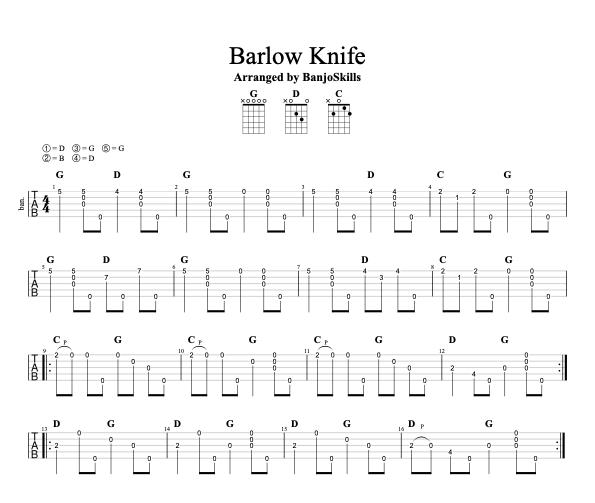
Get the Free Printable Barlow Knife Tab
Download a high-quality, printable PDF version of this tab — free. Keep it on your music stand or take it to your next jam session.
How to Play Barlow Knife - Step by Step
Get the Chord Shapes Ready
We’re in standard open G tuning (gDGBD) for this one, so no retuning necessary. You’ll need three chord shapes: G, D, and C. These are all common shapes you probably already know. Check the chord diagrams at the top of the tab to make sure you’re using the right voicings.
The G chord is your home base. The D chord pops up frequently, and the C chord comes into play in the second and third parts. Practice moving between all three until the switches are smooth.
Learn the A Part
The A part is where the main melody lives. It has a driving, rhythmic feel and mostly sits on the G and D chords. There’s a bit of drop thumb in here, but nothing too tricky. The melody is strong and satisfying on its own, so focus on getting the notes clean and keeping steady time.
Learn the B Part
The B part shifts gears a bit. It introduces the C chord more prominently and has a pull-off into drop thumb pattern that gives it a different texture. This is the trickiest spot in the whole tune. The pull-off and the drop thumb need to flow together smoothly. Take this section slowly and practice that pattern in isolation until it clicks.
The section has a call-and-response feel, bouncing between C and G. Once that pull-off pattern is under your fingers, the rest falls into place.
Learn the C Part
The C part is where the string skipping happens. The melody jumps between strings more than in the other two parts, so your striking hand accuracy really matters here. Keep your right hand relaxed and make sure you stick with the clawhammer motion. If you’re overshooting strings, you’re probably moving too much.
This section bounces between D and G and has a rhythmically satisfying feel. It’s a great finish to the tune before looping back to the beginning.
Make It Your Own
Once you’ve got all three parts under your fingers, play through the whole tune at a comfortable tempo. As you get more confident, you can start adding your own touches. Maybe you emphasize certain brush strokes or add a little rhythmic variation. The melody is the skeleton, and everything else is just personality. Barlow Knife is a crowd-pleaser at jam sessions, so enjoy learning this one.
Practice Tips
- 1
This tune has three parts, so break it down and learn each one separately before connecting them. Trying to learn all three at once is a recipe for frustration.
- 2
The pull-off into drop thumb pattern in the B part is the trickiest spot. Practice that measure on its own until it feels natural, then plug it back into the full section.
- 3
The C part has some string skipping that requires accuracy. Keep your right hand relaxed and make sure you stick with the clawhammer motion. Accuracy first, speed second.
Frequently Asked Questions
What tuning is Barlow Knife played in?
Barlow Knife is played in standard open G tuning (gDGBD). No alternate tunings or capo needed for this one.
Is Barlow Knife hard to play on banjo?
It's an intermediate tune. The chord shapes (G, D, and C) are all beginner-level, but the three-part structure and the string-skipping in the melody add some challenge. If you're comfortable with tunes like Cripple Creek or Old Joe Clark, you're ready to tackle this one.
What chords are used in Barlow Knife?
Three chords: G, D, and C. The G and D chords carry most of the tune, with the C chord adding color in the B and C parts.
Is Barlow Knife the same as Cabin Creek?
Yes, they're the same tune. Fiddle players tend to call it Cabin Creek, while banjo players more commonly call it Barlow Knife. You might hear either name at a jam session.
What's the best way to practice a three-part tune?
Learn each part on its own until you can play it cleanly. Then practice connecting Part 1 to Part 2, then Part 2 to Part 3. Finally, run all three parts together. Don't rush to put it all together before each individual section is solid.