How to Play Little Birdie on Banjo - Clawhammer Tab & Lesson
About This Song
Little Birdie is a beautiful Appalachian folk song that's been sung across the mountains for generations. The lyrics are simple and moving: "Little birdie, little birdie, come sing to me your song, got a short time to stay here and a long time to be gone." It captures that feeling of longing that runs through so much of old-time music.
For banjo players, this is a wonderful beginner tune. This arrangement uses just two chord shapes (C and G, capoed at the 2nd fret to sound in the key of A) and has a simple, beautiful melody that sits naturally on the banjo. The sparse arrangement lets the melody shine. Sometimes less really is more.
Little Birdie Clawhammer Banjo Tab
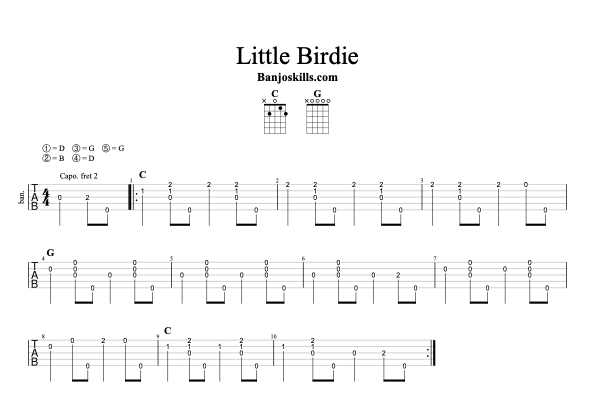
Get the Free Printable Little Birdie Tab
Download a high-quality, printable PDF version of this tab — free. Keep it on your music stand or take it to your next jam session.
How to Play Little Birdie - Step by Step
Set Up Your Capo
Little Birdie is played with a capo at the 2nd fret. This puts the song in the key of A while letting you use your familiar open G chord shapes. You’ll also want to get your 5th string up to A, either by tuning it up or using a 5th string capo at the 2nd fret.
Get the Chord Progression Down
This song uses just two chord shapes: C and G. With the capo at the 2nd fret, these sound as D and A. The song sits on the C shape for several measures, then moves to the G shape before returning to C. That single chord transition is the whole harmonic structure of the song, which means you can really focus on making the melody sing.
Learn the Melody
The melody of Little Birdie is simple and beautiful. It uses a lot of open strings and stays mostly in the first two frets, which keeps things very manageable. The tab shows a straightforward arrangement where the melody notes sit right on top of the bum-ditty rhythm.
Play through the melody slowly, paying attention to which notes fall on the beat and which are part of the rhythm pattern. The 2nd fret notes on the first string are important melody notes that give the tune its character. Let them ring out clearly.
Focus on Your Tone
Because this arrangement is so simple, every note matters. There’s nowhere to hide behind fancy embellishments, which is actually a great thing. It forces you to focus on the fundamentals: clean picking, steady rhythm, and smooth chord transitions.
Pay attention to how your right hand strikes the strings. Aim for a warm, even tone. Let the open strings sustain. The beauty of Little Birdie is in its simplicity, and a clean, unhurried approach will make it sound its best.
Make It Your Own
Little Birdie is one of those songs that sounds different every time you hear it. The spare arrangement in the tab is a perfect starting point, and once it’s comfortable, you can start to explore. Try varying the dynamics, playing some phrases a little louder and others softer. Experiment with your picking position, moving closer to the bridge for a brighter sound or closer to the neck for something warmer. The melody is the anchor, and as long as you keep that intact, you have room to find your own voice in the tune.
Practice Tips
- 1
Since this song only uses two chord shapes (C and G, capoed up to D and A), focus on making that single chord transition as smooth as possible. That one change is the whole song.
- 2
Let the open strings ring out. This arrangement relies heavily on open strings, and the sustained notes are what give Little Birdie its haunting quality.
- 3
Play slowly and deliberately. This is not a fast tune. Let each note have its moment, and focus on getting a clean, even tone with your picking hand.
Frequently Asked Questions
What tuning is Little Birdie played in?
Little Birdie is played in open G tuning (gDGBD) with a capo at the 2nd fret. The capo raises everything to the key of A. You'll want to tune your 5th string up to A as well, or use a 5th string capo.
Is Little Birdie hard to play on banjo?
Not at all. This is a great beginner song. It uses only two chord shapes (C and G with the capo), and the melody is simple and repetitive. If you can play basic bum-ditty rhythm and switch between two chords, you can play Little Birdie.
What are the chords for Little Birdie?
Just two chord shapes: C and G (with the capo at the 2nd fret, these sound as D and A). The song spends most of its time moving between these two chords in a simple, repeating pattern.
Why is there a capo on Little Birdie?
The capo at the 2nd fret puts the song in the key of A. Many traditional versions of Little Birdie are played in A, and the capo lets you use familiar open G chord shapes while sounding in that key. It gives the song a brighter, higher sound that suits the melody.