How to Play Roscoe on Banjo - Clawhammer Tab & Lesson
About This Song
Roscoe is a driving old-time breakdown from the Round Peak region of North Carolina. The tune is named after Roscoe Russell, a well-known banjo maker who taught it to fiddler Kyle Creed. When Creed couldn't remember the tune's original name, he just named it after Roscoe. It's a great story, and it's a great tune.
Roscoe uses just three chords (G, C, and D) and lives in standard open G tuning, but the arrangement here is a step up from beginner tunes. There are pull-offs throughout both parts, and the B part introduces some busier passages that require precision. If you're comfortable with tunes like Cripple Creek and Old Joe Clark and want to step things up, Roscoe is a fantastic next challenge.
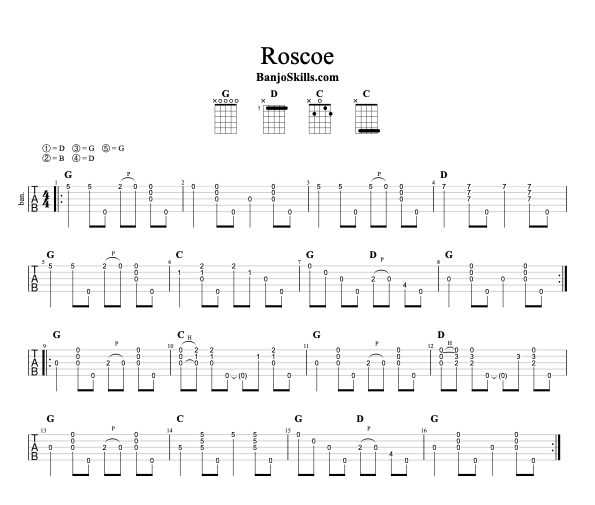
Roscoe Clawhammer Banjo Tab
Get the Free Printable Roscoe Tab
Download a high-quality, printable PDF version of this tab — free. Keep it on your music stand or take it to your next jam session.
How to Play Roscoe - Step by Step
Get the Chord Progression Down
Roscoe is in standard open G tuning (gDGBD), so if you’re already there, you’re ready to go. The tune uses three chords: G, C, and D. The A part sits on G for the first several measures before moving to D and then cycling through C and D at the end. The B part moves to C a bit earlier and has a similar ending. Practice the chord changes until they feel natural before adding the melody.
Learn the A Part
The A part melody has a lot of character right from the start. You’ll notice pull-offs marked throughout the tab. These embellishments give the tune its driving feel, but as always, they’re completely optional. If they’re tricky at first, simplify by just playing the notes straight and add the pull-offs later when you’re comfortable.
Start by playing through the A part slowly, focusing on hitting each pull-off cleanly. The melody moves between the first few frets with some open strings mixed in. Pay attention to the spots where you shift from G to the D chord. That transition needs to be smooth and right on the beat.
Tackle the B Part
The B part introduces the C chord earlier in the progression and has some busier passages. You’ll see hammer-ons marked with H in addition to the pull-offs. These quick embellishments add energy and momentum to the tune.
You’ll also run into a barre chord in this section. If barre chords are new to you, take it slow. The key is applying even pressure across the strings so that each note rings out clearly. If some notes are buzzing or muted, adjust your finger position and pressure until you can hear every string.
Take this section measure by measure. If a particular measure is giving you trouble, isolate it and loop it until it feels comfortable.
Put It All Together
Once both parts feel solid individually, start playing them back to back. The standard structure is AABB, repeating as many times as you want. Focus on making those transitions between the A and B parts feel seamless.
Make It Your Own
Roscoe is a tune that rewards repetition. Each time through, you can vary your dynamics, lean into certain embellishments, or lay back on others. The melody is the anchor, but there’s room to play with the feel and energy. That’s what makes a breakdown like this so fun to play at a jam. It’s the same tune every time, but it never has to sound exactly the same.
Practice Tips
- 1
Isolate the pull-offs that appear throughout both parts and practice them until each one rings out cleanly. A muddy pull-off will drag down the whole tune.
- 2
Work the A part and B part separately until each one is solid on its own. Only then should you start stringing them together. Rushing to play the full tune before the parts are ready just builds in mistakes.
- 3
Pay attention to the chord changes from G to C and G to D. These transitions drive the energy of the tune, so make sure they land right on the beat.
Frequently Asked Questions
What tuning is Roscoe played in?
Roscoe is played in standard open G tuning (gDGBD). No retuning needed if you're already in open G.
Is Roscoe hard to play on banjo?
Roscoe is an intermediate tune. The pull-offs that appear throughout both parts require clean execution, and the B part has some busy passages with quick position shifts. If you're comfortable with beginner tunes and looking for a challenge, Roscoe is a great next step.
What are the chords for Roscoe?
Three chords: G, C, and D. The chord progression follows a standard old-time pattern, but the melody and pull-offs give the tune its distinctive character.
Where did the tune Roscoe come from?
The tune comes from the Round Peak region of North Carolina. Kyle Creed learned it from banjo maker Roscoe Russell, and when he couldn't remember the tune's original name, he named it after Russell. Both musicians were members of the Camp Creek Boys.