How to Play Mississippi Sawyer on Banjo - Clawhammer Tab & Lesson
About This Song
Mississippi Sawyer is one of the all-time classic fiddle tunes, and it's been played by American musicians since at least the early 1800s. The name comes from old river terminology: a "sawyer" was an uprooted tree stuck in the river bottom that created hazards for boats. Fun fact: Mark Twain, who was a licensed riverboat pilot, likely drew on the term when naming his hero Tom Sawyer.
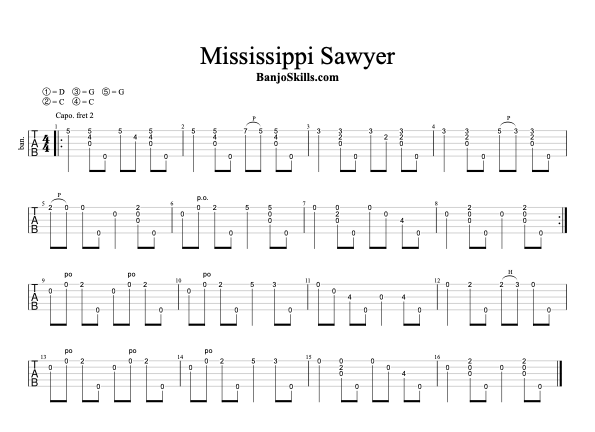
This is an intermediate arrangement in Double C tuning with a capo at the 2nd fret. It leans on alternate string pull-offs and drop thumb, which makes it a great tune for getting those two techniques under your fingers. It sounds fantastic once you get it up to speed.
Mississippi Sawyer Clawhammer Banjo Tab
Get the Free Printable Mississippi Sawyer Tab
Download a high-quality, printable PDF version of this tab — free. Keep it on your music stand or take it to your next jam session.
How to Play Mississippi Sawyer - Step by Step
Get Into Double C Tuning
If you’re coming from open G tuning, you’ll need to make two changes. Lower your 4th string from D down to C, and raise your 2nd string from B up to C. Your tuning should now be gCGCD.
Then place your capo at the 2nd fret and tune your 5th string up to A. This puts you in the key of D.
Learn the A Part
Take the A part measure by measure. The pull-offs live in measures 2, 4, and 5, and the drop thumbs are in measures 1, 3, and 7. Pay attention to where they appear and practice those spots individually.
The A part repeats, so you play it twice before moving to the B part.
Learn the B Part
Break the B part down into small sections and loop each one until it feels comfortable. Don’t worry about speed at this stage. Getting the notes clean is more important than tempo.
There’s a drop thumb in measure 11 and another in measure 15. The B part repeats as well.
Work on the Alternate String Pull-Offs
A good pull-off should sound almost as loud as a struck note. The trick is to keep your fretting finger static and make a slight twisting motion with your wrist. That motion does the work of sounding the string, so you don’t have to yank your finger off.
Practice each pull-off spot on its own. Get a clean, snappy sound from each one before trying to play it in context. Once your pull-offs are solid, the tune will start to flow.
Work on the Drop Thumb
The drop thumbs in this arrangement all land on the 2nd string. The first one is in measure 1: you play the 1st string on beat 3, then your thumb drops to the 2nd string on the “and”. You’ll find the same move in measures 3, 7, 11, and 15.
If drop thumb is new to you, slow way down and make sure your thumb is landing on the 2nd string every time. Play the melody straight first if you need to, then add the drop thumb notes in once the basic shape of the tune feels comfortable. Like all embellishments, they’re optional.
Make It Your Own
Mississippi Sawyer is a tune that fiddlers and banjo players have been interpreting for nearly two centuries, and there are countless versions floating around. Once you’re comfortable with the arrangement in the tab, listen to other recordings and see what ideas you can borrow. The melody is the foundation, and as long as that’s intact, you can shape the embellishments to suit your own style. This is a tune that will grow with you as your playing develops, and it’s one that always turns heads at a jam session.
Practice Tips
- 1
Get comfortable with Double C tuning before diving into the tab. If you're coming from open G, the second and fourth strings will feel different under your fingers.
- 2
The alternate string pull-offs give this arrangement a lot of its character. Once the melody feels comfortable, practice them in isolation and focus on getting a clean, snappy sound from each one.
- 3
Break the tune into four-measure chunks. Learn each chunk until it's solid, then start connecting them. Trying to learn the whole thing at once will slow you down.
Frequently Asked Questions
What tuning is Mississippi Sawyer played in?
Mississippi Sawyer is played in Double C tuning (gCGCD) with a capo at the 2nd fret and the 5th string tuned up to A. This puts the song in the key of D. Double C tuning is the second most common tuning in clawhammer banjo after open G.
Is Mississippi Sawyer hard to play on banjo?
This is an intermediate arrangement. It uses a lot of alternate string pull-offs and drop thumb, so if you've got a few tunes under your belt and have spent some time in Double C tuning, you're ready to tackle it. Take it slow and build up speed gradually.
What is Double C tuning?
Double C tuning is gCGCD, where the 2nd string is raised from B to C and the 4th string is lowered from D to C (compared to open G). It gives the banjo a different, more open sound and is used for many classic fiddle tunes. With the capo at the 2nd fret and the 5th string up to A, you're in the key of D.
What embellishments does this arrangement use?
This arrangement uses a lot of alternate string pull-offs and drop thumb. The pull-offs help connect the phrases of the melody, and the drop thumb fills in notes between the melody. As always, the embellishments are optional. Play the melody straight first, then add them in once it feels comfortable.